The Hollow Earth Files — 5-Part Investigation
On May 22, 1960, the ground beneath southern Chile tore along a fault nearly a thousand kilometers long — the largest earthquake ever instrumentally recorded. Beyond the terrible local toll, something subtler happened, everywhere at once: the entire planet began to ring. Not metaphorically. For days afterward, instruments on every continent recorded the earth swelling and relaxing in slow, global vibrations, the gravest of them repeating about every fifty-four minutes — a chord struck through the whole body of the world. Physicists had predicted those tones for a century. Now they could finally read them, and here is the point of this installment: the notes a struck object sounds depend on what it is made of, all the way through. A bell, a bowling ball, and a basketball do not ring alike. In 1960 the earth told every seismometer on its surface, simultaneously, exactly what it was inside.
The first three parts of this series followed people — astronomers, captains, prophets, admirals, and the mythmakers who worked their reputations like a quarry. This part's protagonists are instruments, because the hollow earth, alone among the legends in this archive, makes a claim that instruments can vote on. This site does not hand down verdicts on mysteries, and will not start here; but a measured planet is not a mystery, and pretending otherwise would be its own kind of dishonesty. What follows is the count — how the interior of a world no one has ever seen came to be mapped anyway — and then, because fairness is the house rule, the strongest objections believers raise, taken seriously and answered specifically. The chapter ends with a debt paid: the compass problem that started this whole story in 1692 finally gets its true answer, and the answer is stranger than Halley's spheres.
The Weight of the World
The first instrument was a mountain. In 1774 the Astronomer Royal, Nevil Maskelyne, camped for months on the flanks of Schiehallion, a conveniently symmetrical Scottish peak, measuring how far its mass pulled a plumb line away from true vertical. From that tiny deflection, and heroic computations by the mathematician Charles Hutton — who invented contour lines in the process of digesting the survey data — came the first decent estimate of the earth's average density: around four and a half times that of water. Two decades later, as Part 1 recounted, Henry Cavendish did it properly with a torsion balance in a shed and got about five and a half — within a couple of percent of the modern value.
Sit with that number, because the entire hollow earth question nearly ends here, in 1798. The rocks of the crust — granites, basalts, the stuff of every continent and seafloor — run about 2.7 to 3.0 times the density of water. The planet as a whole averages 5.5. A hollow planet must average less than its shell, not more; every cavern you excavate drags the average down. Instead the average is roughly double the surface rock, which means the deep interior must be crammed with something far heavier than anything we stand on — iron-heavy matter, ten or more times the density of water, exactly where the theory requires a void. Symmes never engaged the arithmetic. It has never changed.
The Spin Test
A second, independent measurement uses nothing but the planet's rotation. How an object responds to a twist depends not just on its mass but on where the mass sits — the figure-skater principle. Pull the arms in, spin faster; push the mass to the rim, and the object resists turning. Physicists capture this in a single number, the moment of inertia, and the earth's can be measured two ways at once: from the slow 26,000-year wobble of its axis under the pull of the sun and moon, and from the precise way satellites' orbits respond to the equatorial bulge. Both give the same answer, about 0.33 on the standard scale.
Now the comparison. A uniform solid ball scores 0.40. A hollow shell — all mass at the rim — scores about 0.67. The earth's 0.33 sits below uniform, which is only possible if mass is concentrated toward the center, like a ball with a lead heart. The hollow earth does not merely lose this test; it predicts the wrong side of the scale entirely. The planet spins like something dense in the middle, because it is.
Gravity Goes Downstairs
Newton's shell theorem — from the book Halley paid to print — adds the deduction that dooms the inhabited inner surface specifically. Inside a hollow shell, the shell's gravity cancels: a visitor to Symmes's inner lands, or the green valleys of the fake Byrd diary, would not stroll beneath an inner sky. He would float. Interior oceans would drift as globules; interior air would not stay put along the walls. Every illustrated cross-section of a peopled inner world, from 1818 to this morning's video thumbnails, quietly assumes gravity behaving in a way gravity provably does not.
And gravity underground has been checked directly. In 1854, as we saw in Part 1, the Astronomer Royal George Airy timed pendulums at the top and bottom of a deep coal mine and found gravity slightly stronger below — the signature of a planet whose density climbs toward the center. Modern gravimeters lowered down boreholes repeat the result routinely. Teed's concave alternative, for its part, required light itself to bend just so to hide the truth; it answered one measurement, his own, by breaking all the others. Once the rectilineator's four un-replicated miles meet two centuries of replicated everything, there is not much left to argue.
The Planet Learns to Listen
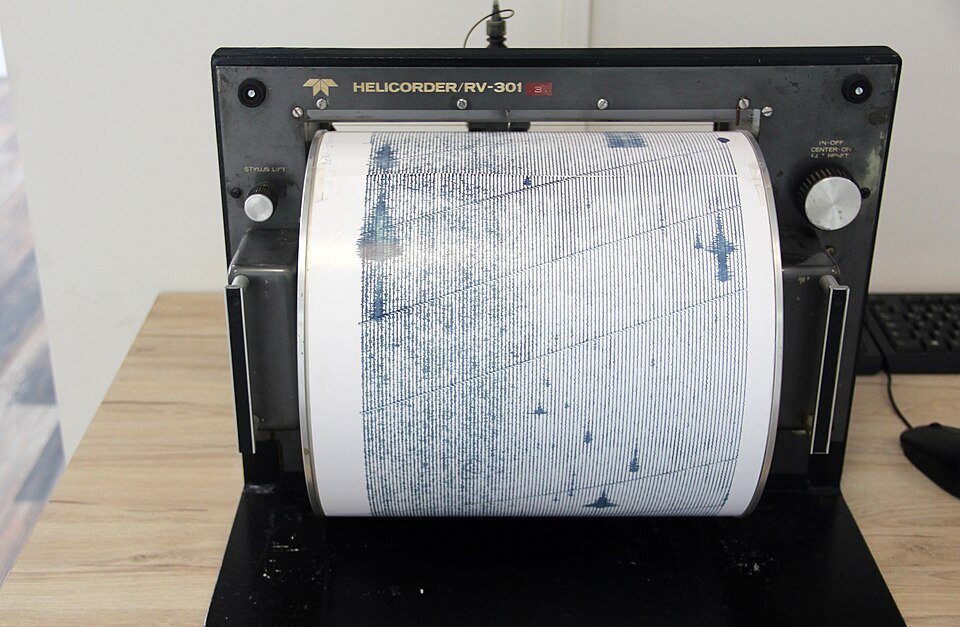
Everything above still only weighs the interior. Seeing into it began with an accident. In April 1889, a delicate pendulum in Potsdam, installed to study tides and the sway of buildings, twitched for no local reason — and an astronomer named Ernst von Rebeur-Paschwitz realized the tremor matched, to the hour, a great earthquake in Japan reported in the newspapers. The shaking had come to Germany through the planet. Every earthquake, it turned out, X-rays the world, and humanity had just noticed the film.
"Of all regions of the earth none invites speculation more than that which lies beneath our feet." — R. D. Oldham, Quarterly Journal of the Geological Society, 1906
The man who wrote that sentence earned it. Earthquakes broadcast two main waves through the deep earth: compressional P waves, which travel through anything, and shearing S waves, which cannot cross a liquid. In 1906 Richard Oldham showed that waves arriving at the far side of the globe were late — delayed as though the planet's heart were a slower, denser region: a core. In 1913 Beno Gutenberg fixed that core's boundary at a depth of about 2,900 kilometers, essentially the modern figure. Then came the shadows, and the shadows are worth pausing on, because their geometry is the fingerprint. Stand more than about 103 degrees of arc away from any earthquake, anywhere on earth, and the S waves never reach you — blocked, every time, by something in the middle that shear cannot cross. The P waves tell a matching story: they vanish over a ring between roughly 103 and 142 degrees, then reappear beyond it, bent inward exactly as compression waves refract when they plunge into a slower liquid. The same two shadows fall across every seismic station on the planet, from every earthquake, in every decade of records. By 1926 Harold Jeffreys had nailed the implication — the outer core has no rigidity at all. It is liquid. A sea of molten metal, wider than the moon, discovered from thousands of kilometers away by listening to where the silence falls.
One more layer remained. In 1936 the Danish seismologist Inge Lehmann, poring over records of Pacific earthquakes — a 1929 New Zealand shock among them — noticed faint P-wave arrivals inside the shadow zone where none belonged, and showed they were bending off something small and solid at the very center: an inner core, floating in the metal sea. She announced it in a paper whose full title was a single character: "P′." It stands among the shortest titles in the history of science, attached to one of the deepest discoveries ever made. By mid-century, without anyone descending past a few kilometers, the earth had been resolved into crust, rocky mantle, liquid outer core, and solid inner core — each layer found, measured, and cross-checked from the surface.
The Bell That Cannot Lie
Which returns us to Chile, 1960, and why the ringing matters so much. Travel-time seismology could conceivably be accused — believers do accuse it — of resting on chains of interpretation. The planet's free oscillations are cruder and more honest: when the whole earth vibrates, the frequencies of its tones are set by the mass, rigidity, and layering of the entire body at once, the way a bell's pitch is set by the whole bell. There is no route around the physics: a hollow sphere and a layered solid one have unmistakably different spectra, as different as a church bell and a basketball. The tones recorded in 1960 — and after every great earthquake since — match the layered model to remarkable precision. They are the basis of the standard reference model of the earth's interior published in 1981 and still in use. Every seismometer on the planet hears the same chord, and the chord has a solid mantle, a liquid outer core, and a solid inner core in it. It does not have a void in it. On this instrument, the planet testifies as a whole, under oath, in public, about once a decade.
Triangulating the Underworld
From the 1960s, the listening became industrial. A worldwide standardized seismograph network was built early in that decade — funded, in one of history's better ironies, largely to catch clandestine nuclear tests — and it incidentally turned the earth's interior into the most surveilled real estate in existence. Today thousands of stations feed public archives, and seismologists run tomography: millions of crossing wave paths, combined like a hospital CT scan, imaging the deep earth in three dimensions. Those paths pass through every cubic kilometer where a hollow would have to be. Waves crossing a great cavity would arrive wildly early, or reflect from its walls, or not arrive at all; instead, global travel times balance to within seconds, everywhere, always.
This model is not an academic ornament; civilization bets money and lives on it daily. Test-ban monitors locate underground explosions to within kilometers and estimate their yields — when North Korea detonated devices beneath a mountain between 2006 and 2017, international networks pinpointed each test within a few kilometers and sized it within hours, using travel times computed through the standard interior. Those are verifiable predictions that keep coming true. The oil and gas industry images the crust with reflected sound and drills nine-figure wells on the results. Earthquake building codes, tsunami warnings, and the gravity corrections inside GPS all lean on the same physics. A wrong model of the interior would not be a quiet scholarly embarrassment. It would be a continuous, expensive, world-visible failure. The failure has never appeared.
Weighing It from Orbit — and with Ghost Particles
The space age added judges with no stake in geology. A satellite's orbit is a continuous measurement of the mass beneath it, and since 2002 the twin GRACE spacecraft and their successors have flown in formation, timing the microscopic stretch and squeeze of the gap between them to map the earth's gravity field month by month. The instrument is sensitive enough to watch India's groundwater being pumped away, to weigh the hundreds of billions of tons of ice Greenland sheds in a year, and to register the mass shifted by a single great earthquake. Europe's GOCE mission, flying a gradiometer at the fringe of the atmosphere from 2009 to 2013, refined the picture further, mapping the planet's true gravitational shape to centimeter-level precision. A planet-scale cavity — a missing world's worth of matter — would not be a subtle feature in such data. It would be the only feature. The maps show a dense, layered, slightly lumpy solid planet, in exact agreement with the seismologists who have never seen the satellites' data pipeline and vice versa.
Particle physics has now testified twice, in fact. Since 2005, detectors buried in Japan and Italy have been catching geoneutrinos — particles emitted by radioactive decay inside the earth itself — and their count answers an old question about the interior's furnace: roughly half the heat flowing out of the planet comes from the slow decay of uranium, thorium, and potassium scattered through the mantle and crust, with the rest left over from the earth's violent formation. The inner sun of Teed and the pulp writers is not needed to warm the underworld; the underworld is its own reactor, and its exhaust is being counted.
Then, in 2018, came the strangest cross-examination yet. Physicists with the IceCube observatory at the South Pole used a year's harvest of atmospheric neutrinos — ghost particles that stream through the planet from every direction — to perform an X-ray no one had attempted: counting how many neutrinos were absorbed along paths through the deep earth. Absorption depends on how much matter lies in the way and on nothing else; the method owes zero assumptions to seismology or gravity. The result: a planet whose mass, and whose denser core, match the standard model of the interior. Three separate windows — gravity, elastic vibration, and particle physics — now look into the same darkness and report the same filled, layered world. Independent witnesses, no shared instruments, one story.
The Objections, Taken Seriously
Fairness is the house rule, so here are the strongest cards in the believers' hand, played face up. "No one has ever been down there." True. The deepest humans have drilled is the Kola Superdeep Borehole in Arctic Russia — 12,262 meters, about a fifth of one percent of the way to the center, abandoned when temperatures near 180 degrees Celsius made further progress impractical. But note two things. Kola's surprises — unexpected water, rocks hotter than predicted — were published, loudly, by the same geoscience establishment supposedly guarding secrets; science advertises its anomalies. And "no direct visit" proves less than it seems: no one has visited the sun's interior either, yet its structure is known finely enough to predict its oscillations. Instruments are how humans know almost everything worth knowing about places bodies cannot go.
"Satellite photos show the polar opening." One image carries most of this claim: a 1968 mosaic from the ESSA-7 weather satellite with a neat black disc over the North Pole. The disc is the mosaic. The picture was stitched from many orbital passes, and the pole — then in the depths of its months-long winter night, and at the geometric edge of every pass — went unimaged and was rendered dark. The photograph was promoted as a hole by Ray Palmer, making his third appearance in this series, in 1970. Continuous modern polar imagery, decades of overflights, a permanently staffed station at the South Pole since 1957, and the simple fact that GPS geometry would collapse around a missing chunk of planet have not retired the image online. Mosaics are forever.
"Gravity experiments have shown anomalies." The perennial citation is a set of plumb-line experiments in a Michigan copper mine around 1901, where two weights hung down a deep shaft appeared to diverge oddly. Follow-up work at the time traced the effect to air currents in the ventilated shafts and to survey error, and the result was never reproduced under controlled conditions — a story with the same anatomy as the rectilineator in Part 1: one uncontrolled measurement, endlessly recycled, against a mountain of controlled ones. "But what about the driftwood?" The oldest evidence file of all deserves an answer too. Symmes built his case partly on genuine Arctic observations — timber washing up on treeless polar shores, animals and birds streaming north in spring as if toward pasture, whalers' reports of open water beyond the ice. All real; all since explained above ground. The driftwood is Siberian, rafted across the basin by the mapped Transpolar Drift current; the migrants are heading to the Arctic's own summer breeding grounds, tracked now by satellite tag; the open water is polynyas and leads that polar oceanographers chart season by season. Symmes reasoned honestly from the data of 1818. The data of 2026 have homes for every anomaly he collected — on the outside. "The auroras are inner light leaking out." This was Halley's own suggestion in 1716, and it deserves a respectful retirement rather than a sneer: made before anyone knew of the solar wind, it was a reasonable guess. Today auroras are photographed from above as glowing ovals ringing the magnetic poles — not disks capping them — and they arrive on schedule with eruptions on the sun, forecast days ahead by space-weather offices. Light from below would do neither.
"The scientists are all in on it." Consider the required payroll. Seismic and gravity data are gathered by rival nations that agree on nothing else, published in open archives anyone can query, and duplicated by hobbyists — thousands of citizen seismometers stream live from garages and classrooms, and any physics department can rerun the numbers. A conspiracy would need every government, every oil company betting billions on crustal images, every insurance actuary, and every amateur with a home sensor. And one more thing, offered in the spirit of this series: the hollow earth is testable, so here is the test. A hollow planet would show gravity weakening rapidly with depth, a moment of inertia above 0.40, early or missing wave arrivals along cavity paths, a shell's vibration spectrum, satellite gravity deficits, and a neutrino surplus along chords through the void. Any one of these, verified, would overturn the model and mint Nobel Prizes. None has ever been observed. The door is not locked. It is open, with instruments pointed at it.
The Real Anomalies
If the case is closed on hollowness, the interior is not thereby boring — and honesty requires showing what genuine deep-earth mystery looks like, because there is plenty. At the bottom of the mantle sit two continent-sized regions, one beneath Africa and one beneath the Pacific, where seismic waves drag as though moving through something different — provinces the size of hemispheres whose origin is openly contested; one recent hypothesis, still being argued in the journals, proposes they are buried fragments of Theia, the Mars-sized body whose impact formed the moon. The solid inner core appears to rotate at its own slightly different rate, and studies in the last few years suggest that rotation may have recently slowed or begun oscillating — a live debate conducted in public; other researchers, reading subtle differences in how waves cross the center, have proposed a distinct "innermost" kernel several hundred kilometers across, a core within the core. A 2014 diamond carried up an inclusion of ringwoodite holding water locked in its crystal structure, implying oceans' worth of water bound chemically in mantle rock — bound in mineral, it must be said plainly, not sloshing in caverns, however the headlines read. There may be iron "snow" falling in the outer core. The real underworld is a place where rock flows like glacier ice, metal weather rages, and continents of anomaly sit unexplained at the planet's heart. It out-stranges the tunnels. It merely refuses to be empty.
Halley's Answer
Which leaves one debt outstanding. This series began with a data problem: Edmond Halley's 1692 discovery that the compass slowly drifts, which he explained with magnetized spheres turning inside a hollow shell. The drift was real. Halley was right that something vast was rotating down there, right that it was magnetic, right that the answer lay in the deep interior — wrong only about the emptiness. The modern answer is the geodynamo: the liquid iron ocean Jeffreys proved and Lehmann bounded, churning as the planet turns, generating the magnetic field as a self-sustaining dynamo. The field's features wander westward with the core's flow — the very drift Halley measured — and its deeper history lies recorded in magnetic stripes on the ocean floors: full reversals of north and south, dozens of them, plus briefer stumbles like the excursion 41,000 years ago when the field sagged to a fraction of its strength before recovering. Compass needles, it turns out, have been reporting the weather in a metal sea all along. The first respectable hollow earth theory was a nearly correct theory of the core, minus the core. It took 250 years of instruments to fill in the sphere Halley emptied, and the filling turned out to be a hidden metal sea with weather of its own — a stranger answer than his, and a true one.
So the physics closed its file — Cavendish opening it, the satellites and the ghost particles signing off. And yet: the belief did not close with it. By every measure of attention, the hollow earth has more adherents today than at any time since Symmes died lecturing, and they are organized, prolific, and often perfectly sincere. Who are they? What do they actually claim in 2026, from Agartha channelers to polar-expedition crowdfunders? And what does the theory's third century say about how belief works in the age of the algorithm? That is Part 5 — the finale.
Sources & Further Reading
- Maskelyne, Nevil. "An Account of Observations Made on the Mountain Schehallien for Finding Its Attraction." Philosophical Transactions of the Royal Society, Vol. 65 (1775); with Hutton, Charles, computational report, Philosophical Transactions, Vol. 68 (1778).
- Cavendish, Henry. "Experiments to Determine the Density of the Earth." Philosophical Transactions of the Royal Society, Vol. 88 (1798).
- Airy, George Biddell. "Account of Pendulum Experiments Undertaken in the Harton Colliery." Philosophical Transactions of the Royal Society, Vol. 146 (1856).
- Rebeur-Paschwitz, Ernst von. "The Earthquake of Tokio, April 18, 1889." Nature, Vol. 40 (1889).
- Oldham, Richard Dixon. "The Constitution of the Interior of the Earth, as Revealed by Earthquakes." Quarterly Journal of the Geological Society, Vol. 62 (1906).
- Gutenberg, Beno. Determinations of the core boundary, in Nachrichten der Gesellschaft der Wissenschaften zu Göttingen (1913–14).
- Jeffreys, Harold. "The Rigidity of the Earth's Central Core." Monthly Notices of the Royal Astronomical Society, Geophysical Supplement, Vol. 1 (1926).
- Lehmann, Inge. "P′." Publications du Bureau Central Séismologique International, Série A, Vol. 14 (1936).
- Benioff, Hugo; Press, Frank; and Smith, Stewart. "Excitation of the Free Oscillations of the Earth by Earthquakes." Journal of Geophysical Research, Vol. 66 (1961) — on the 1960 Chile earthquake.
- Dziewonski, Adam, and Anderson, Don. "Preliminary Reference Earth Model." Physics of the Earth and Planetary Interiors, Vol. 25 (1981).
- Kozlovsky, Yevgeny, ed. The Superdeep Well of the Kola Peninsula. Springer, 1987.
- Tapley, Byron, et al. "GRACE Measurements of Mass Variability in the Earth System." Science, Vol. 305 (2004); with NASA/JPL mission documentation for GRACE-FO (2018– ).
- KamLAND Collaboration. "Experimental investigation of geologically produced antineutrinos with KamLAND." Nature, Vol. 436 (2005); with subsequent geoneutrino results from the Borexino Collaboration.
- Donini, Andrea; Palomares-Ruiz, Sergio; and Salvado, Jordi. "Neutrino Tomography of Earth." Nature Physics, Vol. 15 (2019).
- Pearson, D. G., et al. "Hydrous mantle transition zone indicated by ringwoodite included within diamond." Nature, Vol. 507 (2014).
- Yuan, Qian, et al. "Moon-forming impactor as a source of Earth's basal mantle anomalies." Nature, Vol. 623 (2023).
- Yang, Yi, and Song, Xiaodong. "Multidecadal variation of the Earth's inner-core rotation." Nature Geoscience, Vol. 16 (2023).
- NOAA/ESSA satellite program records, 1968 (the ESSA-7 polar mosaic); Palmer, Ray, ed. Flying Saucers, June 1970.