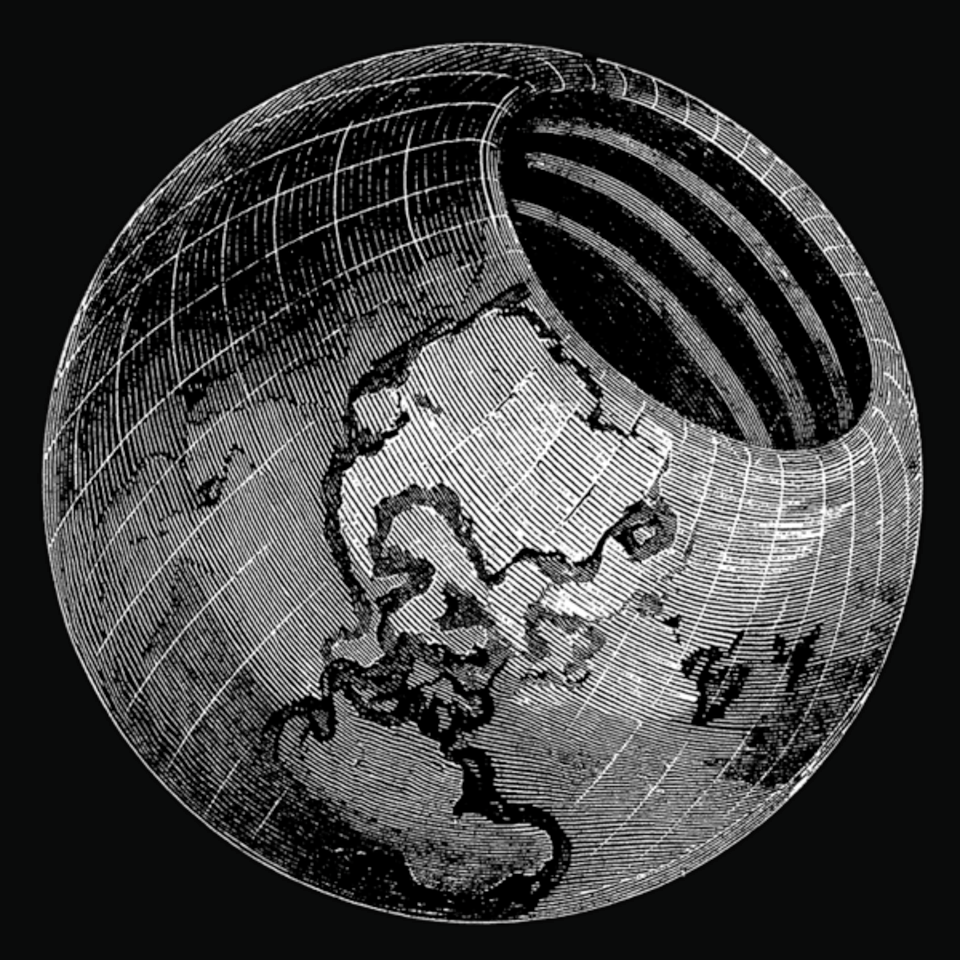
The Hollow Earth Files — 5-Part Investigation
In the spring of 1818, packets began arriving at statehouses, newspaper offices, colleges, and learned societies across the United States and Europe. Each contained a single printed sheet, dated at St. Louis in the Missouri Territory on April 10, and addressed, without apparent irony, "To All the World." Its author came directly to the point:
"I declare the earth is hollow, and habitable within; containing a number of solid concentrick spheres, one within the other, and that it is open at the poles 12 or 16 degrees; I pledge my life in support of this truth, and am ready to explore the hollow, if the world will support and aid me in the undertaking." — John Cleves Symmes Jr., Circular No. 1, April 10, 1818
The author, a retired army captain turned frontier trader, anticipated the obvious objection. Enclosed with the declaration, by most contemporary accounts, was a second document: a certificate attesting to his sanity.
It would be easy to file the circular under frontier eccentricity — the newspapers of the day largely did. But the idea Symmes pledged his life to was not his own invention. It had entered the scientific record 126 years earlier, in the pages of the Royal Society's Philosophical Transactions, under the name of one of the most accomplished astronomers who ever lived. And it would outlast Symmes by centuries, mutating from a respectable hypothesis into a congressional petition, a utopian religion, a staple of pulp fiction, and eventually a fixture of modern conspiracy culture.
This is the first installment of The Hollow Earth Files, a five-part investigation into where the hollow earth theory came from, who carried it, what evidence its believers have offered, and what the geological record actually shows. Part 1 traces the theory's first two centuries — roughly 1692 to 1900 — through four men: an astronomer with a data problem, a soldier with a mission, a lobbyist who got his expedition, and a prophet who tried to measure his way inside.
The Astronomer's Problem
Edmond Halley is remembered for the comet that bears his name, but in the 1680s and 1690s his working obsession was the compass. Magnetic navigation was the backbone of European seafaring, and it had a known defect: the needle does not point true north, and the size of the error — the "variation" — differs from place to place. Worse, as decades of ships' logs made clear, the variation at any given port was slowly drifting. A correction table drawn up for one generation of navigators was quietly wrong for the next.
Halley took the drift seriously as a physical fact demanding a physical cause. In a 1683 paper he mapped the world's magnetic behavior and concluded that no simple two-pole magnet could explain it; the earth, he argued, behaved as though it had four magnetic poles. That still left the harder question of why the pattern moved. His answer arrived in 1692, in a paper presented to the Royal Society under a title that stated its ambition plainly: "An Account of the cause of the Change of the Variation of the Magnetical Needle; with an Hypothesis of the Structure of the Internal parts of the Earth."
The hypothesis was this: the earth we stand on is an outer shell, roughly five hundred miles thick, and inside it — separated by some intervening medium — turn one or more inner globes, each magnetized, each rotating at very slightly different rates. Two of the four magnetic poles belonged to the outer shell and two to an inner sphere; as the inner sphere's rotation lagged behind the shell's, its poles slid slowly westward beneath our feet, and the compass variation drifted with them. In its fullest form, Halley's model held nested spheres comparable in size to Venus, Mars, and Mercury, arranged one inside the other like the layers of an onion, down to a solid central core.
Halley understood how the proposal sounded, and he worked through the objections in print. What keeps the inner spheres centered and apart? Gravity and the original disposition of the Creator, he answered. Would the ocean not drain through any crack in the shell? The shell, he argued, could be watertight. What of the darkness inside? Here Halley allowed himself to speculate that the inner skies might glow with their own light, and he pressed further still. "I have adventured to make these Subterraneous Orbs capable of being inhabited," he wrote — reasoning, in the theological idiom of his century, that a wise Creator would hardly build vast interior worlds and leave them empty. In 1716, asked to explain a spectacular aurora over England, he returned to the idea, suggesting that glowing matter from the interior might escape where the shell was thinnest, at the poles.
None of this was fringe behavior by the standards of 1692. There were no seismographs. The mass of the earth would not be measured for another century. Halley had a real dataset, a real anomaly, and a mechanical model that accounted for it — which is precisely why the Royal Society printed the paper. Nor did Halley ever treat the idea as a youthful indiscretion. When he sat for his official portrait around 1736, an eminence of nearly eighty and Astronomer Royal, he chose to be painted holding a diagram of the earth's concentric interior spheres.
The Man Who Paid for His Own Undoing
Here the story acquires the first of its many ironies. In 1684, it was Halley who rode to Cambridge to coax a reclusive Isaac Newton into writing up his work on gravitation. And when the Royal Society — its budget exhausted by a lavish illustrated volume on the natural history of fish — could not afford to publish the result, it was Halley who paid for the printing of the Principia Mathematica out of his own pocket.
The book Halley financed contained, in Book I, a result now called the shell theorem: inside a uniform hollow sphere, the gravitational pull of the shell cancels out entirely. A person standing on the inner surface of a hollow planet would not be held to the ground at all. Whatever Halley's rotating spheres could explain about compasses, Newton's own geometry made an inhabited inner surface — the version of the hollow earth that would dominate the next three centuries — a physical impossibility, at least by gravity as Newton described it. Later hollow earth writers would spend enormous ingenuity trying to argue their way around that theorem. It has never moved.
There is a second, subtler irony that historians of science have noted. Part of what made a partly hollow earth seem plausible to Halley was a figure in the first edition of the Principia itself: Newton's early calculation implying that the moon was substantially denser than the earth. If the earth was the lighter body, Halley reasoned, perhaps it was lighter because it was partly empty. Newton revised the lunar figure in later editions, and that leg of the argument quietly dissolved. The decisive measurement came in 1798, more than half a century after Halley's death, when Henry Cavendish used a torsion balance to weigh the earth itself. The planet's mean density came out around five and a half times that of water — roughly double the density of the rock at the surface. Whatever is down there, the measurement said, there is more of it than up here, not less. The interior was denser than the crust, not emptier.
By the time Cavendish published, Halley's spheres had been retired from working science. The idea might have ended there — a defensible seventeenth-century hypothesis, superseded. Instead, twenty years after Cavendish, it re-emerged on the American frontier, transformed from an explanation into a destination.
Captain Symmes Pledges His Life
John Cleves Symmes Jr. was born in New Jersey in 1780, nephew and namesake of a prominent Continental Congress delegate and Ohio land pioneer. He joined the army, and in the War of 1812 he fought creditably in some of its hardest engagements on the Niagara frontier, including Lundy's Lane and the defense of Fort Erie. After the war he mustered out a captain and set up as a trader supplying army posts, working out of St. Louis. It was from there, at thirty-seven, that he mailed his declaration to the world.
Circular No. 1 was not merely a manifesto; it was an expedition proposal. Symmes asked for "one hundred brave companions, well equipped, to start from Siberia in the fall season, with Reindeer and slays, on the ice of the frozen sea," and promised that beyond latitude 82 they would find "warm and rich land, stocked with thrifty vegetables and animals if not men." In the developed version of his theory, recorded by his followers, the polar openings were immense — on the order of four thousand miles across in the north and six thousand in the south — with rims so gradual that a traveler could sail over the edge and down onto the inner surface without ever noticing the transition. The warm interior seas, he argued, explained real puzzles of the day: the northward migrations of animals in spring, the driftwood and seeds that washed up on Arctic shores, the reports from whalers of open water beyond the ice.
The press response was immediate and merciless. "Symmes's Hole" became a national punchline, an all-purpose joke about where lost things and bad ideas go. Symmes answered the ridicule the only way available to a man of limited means and unlimited conviction: he lectured. From 1820 until his health gave out, he crossed Ohio, Kentucky, and the eastern states, speaking in courthouses, churches, and lyceum halls with a globe and homemade diagrams. Contemporaries agreed on two things — that he was a poor, halting speaker, and that his evident sincerity was difficult to laugh at in person.
The lectures produced converts, and the converts produced institutions' worth of effort. James McBride, a respected Ohio businessman, compiled the theory into a book, Symmes's Theory of Concentric Spheres, published in 1826. Petitions on Symmes's behalf reached the Ohio legislature and both houses of Congress in 1822 and 1823; Senator Richard M. Johnson of Kentucky — later vice president of the United States — presented one. The petitions asked for ships, men, and equipment to test the theory at the poles. Each was tabled, though contemporary accounts record that one associated motion drew some two dozen supporting votes. A reported invitation to join a Russian polar expedition came to nothing; Symmes could not afford his own outfit and passage.
One more artifact of the Symmes years deserves mention. In 1820, a novel titled Symzonia: A Voyage of Discovery appeared under the byline "Captain Adam Seaborn," describing a steamship voyage through the southern polar opening into a luminous inner world inhabited by a pale, virtuous race — and naming the inner continent in Symmes's honor. Whether Symmes wrote it himself as promotion, or someone else wrote it as satire, remains genuinely unsettled among scholars; the book reads plausibly as either. Sometimes cited as the first American utopian novel, it marks the moment the hollow earth crossed from proposal into literature, a migration that would matter enormously later in this series.
Symmes never got his expedition. Worn down by a decade of touring, he died in Hamilton, Ohio, in May 1829, at forty-eight. His son Americus later raised a monument over the grave: a stone obelisk crowned with a carved globe, hollow and open at the poles. It stands in Hamilton to this day.
The Lobbyist Who Got the Ships
The expedition Symmes died asking for did eventually sail — stripped of his theory, and without the man who did most to launch it.
Jeremiah N. Reynolds was a young Ohio newspaper editor when he took up the Symmes cause in the mid-1820s, joining the captain on the lecture circuit and quickly proving the better advocate. He was also a better strategist. Somewhere on tour, Reynolds made a calculated pivot: he quietly dropped the concentric spheres and reframed the goal as a national voyage of exploration to the far south — for science, for the whaling and sealing industries, for American prestige. Congress could laugh at a hole at the pole. It was harder to laugh at charts, harbors, and commerce.
The repackaged campaign nearly succeeded at once. In 1828 the House moved on the idea and the administration of John Quincy Adams backed preparations for a South Seas expedition. (A durable internet legend holds that Adams approved a mission to the earth's interior; the record shows he supported Reynolds's oceanic survey, which by then had shed Symmes's cosmology.) The election of Andrew Jackson stalled the project, and Reynolds went south anyway, joining a private sealing and exploring venture toward Antarctic waters in 1829. The voyage delivered him years of adventure along the Chilean coast — where he collected the story of a notorious white bull whale called Mocha Dick. His 1839 magazine account of that whale would hand a young Herman Melville half a title and the seed of an American epic.
Back home, Reynolds waged a long public war of pamphlets and petitions, culminating on April 2, 1836, when he was granted the unusual honor of addressing Congress from the Hall of the House of Representatives. He spoke for hours on the scientific and commercial case for a great national expedition. Weeks later, Congress authorized and funded it. After two more years of bureaucratic delay — and a feud with the Secretary of the Navy so venomous that it got him struck from the roster — the United States Exploring Expedition sailed in August 1838 under Lieutenant Charles Wilkes. Reynolds, its indispensable author, watched from shore.
The "Ex. Ex." became one of the most consequential voyages in American history: six ships, four years, tens of thousands of miles logged, hundreds of Pacific islands and harbors charted — some of those charts still in use during the Second World War — and, in January 1840, a long run along an icy coastline that established Antarctica as a continental landmass. The stretch Wilkes mapped still bears his name. The expedition's specimens and artifacts came home by the ton and helped seed the collections of the new Smithsonian Institution.
Note what had happened. A lecture tour for a hollow planet had, through one determined convert, helped will into existence the very survey that mapped a solid continent across the theory's southern doorway. Believers at the time were undeterred — the openings, they noted, could simply lie beyond the charted coasts, farther in than any ship had reached. It was the first appearance of a pattern this series will meet again: every expedition that fails to find the entrance becomes, for the committed, evidence only of how well hidden it is.
Reynolds drifted out of exploration and into law, but he left one more strange mark on American letters. Edgar Allan Poe followed his career closely, lifted passages of his congressional address into The Narrative of Arthur Gordon Pym — a novel that ends with its narrator swept toward a vast chasm at the South Pole — and, according to the physician who attended Poe's delirious final night in 1849, spent hours calling out the name "Reynolds." Poe scholars have long questioned that account, which grew more elaborate each time the doctor retold it. Like much in this story, the legend has proven sturdier than the sourcing.
Closing the Books, Opening the Myth
Through the middle of the nineteenth century, the scientific case against a hollow planet hardened from every direction at once. Cavendish's density figure stood. In the 1850s the Astronomer Royal, George Airy, ran pendulum experiments at the top and bottom of a deep English coal mine and confirmed that gravity behaves as it should above a dense interior. Geologists mapped heat increasing steadily with depth. By century's end, the first seismographs were listening to earthquakes travel through the planet — the beginning of a body of evidence, examined in Part 4 of this series, that would eventually image the interior in detail.
Retired from the journals, the hollow earth migrated into print culture and began, tellingly, to invent its own past. Jules Verne sent readers underground in 1864. And twentieth-century hollow earth writers would routinely add a distinguished name to the theory's roster: the great mathematician Leonhard Euler, credited again and again with proposing a hollow globe lit by a central sun. No such proposal has been located in Euler's published work; his famous thought experiment concerned a hole bored through a solid earth, not a hollow one. The attribution appears to be the theory's literature citing itself — a caution worth carrying through everything that follows in this series.
By the 1860s, then, the hollow earth was scientifically orphaned but culturally alive. It needed only someone to give it a soul. In the autumn of 1869, in a workshop in upstate New York, it found him.
The Prophet of the Inside
Cyrus Reed Teed was an upstate New York physician of the "eclectic" school — a nineteenth-century medical movement heavy on botanical remedies — with a private passion for electrical and alchemical experimentation. By his own account, one night in 1869 in his laboratory near Utica, the thirty-year-old Teed was visited by a luminous female figure who revealed to him the true structure of the universe. He did not treat the experience as a metaphor. He treated it as data, and he spent the rest of his life building a science, a scripture, and a city on it.
Teed's cosmology inverted every hollow earth idea that had come before. Halley and Symmes had imagined worlds nested inside our own; Teed announced that we are the ones inside. In his "cellular cosmogony," the entire universe is contained within a hollow sphere about eight thousand miles across. Humanity lives on the concave inner surface of its shell — a crust roughly a hundred miles thick, elaborately stratified with layers of metals and minerals. At the center hangs an electromagnetic sun, one hemisphere light and one dark, whose rotation produces day and night. The sun we see, the moon, the planets, the stars: all, in Teed's system, are optical phenomena — reflections and focalizations of light within the cell. Light rays themselves curve, which is why the ground appears to fall away at a horizon rather than rise up around us like the inside of a bowl.
The system had, for its followers, a powerful emotional logic. Copernican astronomy had made the earth a speck adrift in an infinite void; Teed's cosmos was finite, enclosed, and centered on humanity, with nothing outside the shell but solid matter and God. To settle the shape of the earth, he taught, was to settle everything else. He renamed himself Koresh — the Hebrew form of Cyrus — and named his movement Koreshanity.
It grew. After a well-received 1886 appearance before a mental science convention in Chicago, Teed relocated there and built the Koreshan Unity into a genuine communal movement: property held in common, celibacy for the inner circle, and — unusually for the era — women in visible leadership, with Annie G. Ordway, under the name Victoria Gratia, installed as co-leader. In 1894, on land acquired from a German settler on the Estero River in southwest Florida, Teed began building his "New Jerusalem," a planned city he projected would one day hold ten million people. At its peak the actual settlement housed a couple hundred, but what they built was real: gardens, a bakery, a sawmill, a publishing house, and some of the first cultural life in that corner of Florida.
And unlike any hollow earth advocate before him, Teed proposed to prove his cosmos with an instrument.
Four Miles of Certainty
The logic of the test was elegant. On a convex earth, a perfectly straight horizontal line projected above the sea will rise ever higher above the water as the surface curves away beneath it. On Teed's concave earth, the same line will run into the water, because the surface curves up. All you need is a truly straight line, several miles long, and a beach flat enough to build it on.
The instrument was the work of Ulysses Grant Morrow, a newspaperman and self-taught geodesist who had become Teed's scientific lieutenant. He called it the rectilineator: a series of twelve-foot double-T-square frames of seasoned mahogany, fitted with brass facings, each section mounted on adjustable standards and registered precisely against the one before it. By repeatedly moving the rearmost section to the front — checking each junction with levels and plumbs, inverting sections to cancel any bias built into the frames themselves — the apparatus could, in principle, extend a straight line indefinitely.
In the first days of January 1897, Morrow's "Koreshan Geodetic Staff" began operations on the long, flat Gulf beach at Naples, Florida, starting their line 128 inches above the water datum. The work was slow, ceremonial, and meticulously logged. Section by section, over roughly five months, the line crept more than four miles down the coast — and, according to the staff's measurements, steadily closed the gap to the water, meeting it at a little over four miles out. The curvature they computed from the descent implied a concave surface with a circumference of about 25,000 miles: the accepted size of the earth, turned inside out. The Unity published the results, with photographs and engravings of the apparatus, in an 1898 volume whose title announced the verdict — The Cellular Cosmogony, or the Earth a Concave Sphere.
What should a fair-minded reader make of the experiment? Two things can be true at once. The first is that the Koreshans were not frauds. They published their method and their numbers, worked in public, and plainly believed they were doing rigorous science; in an age of crank pamphlets, they built hardware. The second is that the experiment's design could not deliver what it promised. Any tiny, consistent mechanical error at each junction — a hair's settling under the weight of a new section, a systematic bias in how the brass faces seated — does not average out. It compounds, mile after mile, in one direction. Later analyses have pointed out that a repeated downward error far smaller than anything the staff could have detected at a single junction, sustained across the roughly eighteen hundred couplings of a four-mile line, is enough to reproduce the entire observed descent on an ordinary convex earth. The rectilineator was, in effect, an instrument for accumulating its own droop — and the droop pointed exactly where the theory needed it to.
The staff sought no independent replication, and no surveyor outside the movement ever obtained the Koreshan result. But the deeper tell may be the perfection of the outcome. The line met the water at almost precisely the distance a 25,000-mile concave earth predicts — the textbook circumference of the planet, inverted. To the faithful, that concordance was confirmation. To a metrologist, an experiment that confirms its hypothesis to the decimal, on the first try, with homemade equipment, is not usually announcing a new cosmos. It is usually measuring itself.
Death in Estero
Teed's movement did not outlive its founder's body by much — in part because the movement had staked so much on that body. Koreshan doctrine taught that Teed would not die in the ordinary sense but would undergo transformation and return.
In 1906, the Unity's entry into local politics made enemies in nearby Fort Myers, and in October of that year Teed was badly beaten in a street confrontation. His health declined afterward, and he died at Estero on December 22, 1908. His followers, expecting resurrection, kept watch over the body for days — until the county health officer intervened and ordered a burial. Teed was entombed in a mausoleum on the Gulf shore of Estero Island. In 1921, a hurricane swept the tomb into the sea. The body was never recovered.
The colony persisted in dwindling numbers for another half century. In 1961, the last members deeded the settlement to the State of Florida, and today the site is preserved as Koreshan State Park. Visitors can walk the grounds of the New Jerusalem, past the restored buildings of a community founded on the proposition that they, and everyone they had ever known, were living on the inside.
An Idea, Open at the Poles
Stand back from the first two centuries and the arc is unmistakable. The hollow earth entered the world in 1692 as normal science — a testable model, built by a first-rank astronomer to explain a genuine anomaly, published by the Royal Society. Over the next two hundred years, the measurements came in: the weight of the planet, the behavior of gravity in deep mines, the heat of the crust, the first tremors traced through the interior. At every step, the science moved one way. And at every step, the idea, rather than dying, changed registers — from hypothesis to expedition proposal, from expedition proposal to novel, from novel to revelation. Each of its nineteenth-century champions lost his personal campaign. Symmes never got his ships. Reynolds got the ships and was left on the dock, and the voyage mapped a continent across the southern opening. Teed built his instrument, and the instrument measured its own sag. Yet in 1900 the hollow earth commanded more believers than it had in 1800.
That resilience is the real subject of this series, and the next chapters follow the idea into stranger territory. Even as Teed's surveyors worked the beach at Naples, occult writers in Europe were relocating the interior world from physics into myth — a hidden kingdom beneath Asia, ruled by masters of a lost science, reachable not by ship but by initiation. Its names were Agartha and Shambhala, and its story — where it actually came from, and how a Tibetan Buddhist tradition was rewritten into a subterranean empire — is the subject of Part 2.
The captain, at least, has his monument. In a small park in Hamilton, Ohio, atop a weathered obelisk raised by his son, sits a stone globe pierced through at the poles — a grave marker for a man, and a portrait of an idea that has never yet agreed to be buried.
Sources & Further Reading
- Halley, Edmond. "An Account of the cause of the Change of the Variation of the Magnetical Needle; with an Hypothesis of the Structure of the Internal parts of the Earth." Philosophical Transactions of the Royal Society, Vol. 16 (1692), pp. 563–578.
- Halley, Edmond. Paper on the aurora of March 1716, attributing polar lights to luminous matter from the earth's interior. Philosophical Transactions of the Royal Society, Vol. 29 (1716).
- Newton, Isaac. Philosophiæ Naturalis Principia Mathematica. London, 1687. Book I, Section XII (the shell theorem).
- Cavendish, Henry. "Experiments to Determine the Density of the Earth." Philosophical Transactions of the Royal Society, Vol. 88 (1798).
- Symmes, John Cleves Jr. Circular No. 1. St. Louis, Missouri Territory, April 10, 1818.
- McBride, James. Symmes's Theory of Concentric Spheres. Cincinnati: Morgan, Lodge and Fisher, 1826.
- [Seaborn, Adam, pseud.] Symzonia: A Voyage of Discovery. New York: J. Seymour, 1820. Authorship disputed.
- Reynolds, Jeremiah N. Address, on the Subject of a Surveying and Exploring Expedition to the Pacific Ocean and South Seas. Delivered in the Hall of Representatives, April 2, 1836. New York: Harper & Brothers, 1836.
- Reynolds, Jeremiah N. "Mocha Dick: or the White Whale of the Pacific." The Knickerbocker, May 1839.
- Wilkes, Charles. Narrative of the United States Exploring Expedition. Philadelphia: Lea and Blanchard, 1845.
- Airy, George Biddell. "Account of Pendulum Experiments Undertaken in the Harton Colliery." Philosophical Transactions of the Royal Society, Vol. 146 (1856).
- Teed, Cyrus R. (Koresh) and Morrow, Ulysses G. The Cellular Cosmogony, or the Earth a Concave Sphere. Estero, FL: Guiding Star Publishing House, 1898.
- Florida Department of Environmental Protection. Koreshan State Park — historical materials on the Koreshan Unity settlement at Estero. FloridaStateParks.org.
- Smithsonian Institution. Collections and institutional history of the United States Exploring Expedition (1838–1842). SI.edu.
- Millner, Lyn. The Allure of Immortality: An American Cult, a Florida Swamp, and a Renegade Prophet. University Press of Florida, 2015.
- Edgar Allan Poe Society of Baltimore. Scholarship on John J. Moran's accounts of Poe's final days (1849). EAPoe.org.