The Hollow Earth Files — 5-Part Investigation
On the internet's telling, the morning of February 19, 1947, began routinely. Admiral Richard E. Byrd, the most famous polar explorer alive, lifted off from an Arctic base camp for a survey flight toward the North Pole. Then his instruments spun, the ice below gave way to green valleys and rolling hills, an animal resembling a mammoth moved through the vegetation, and disc-shaped craft rose to meet the plane. The discs bore, the account notes, "a type of Swastika." Byrd was escorted down into a gleaming city, brought before a tall, fair being called the Master, lectured on humanity's reckless embrace of atomic weapons, and sent back to the surface with a message. Weeks later, at the Pentagon, he was debriefed, sworn to silence, and placed under watch. He confided everything to a secret diary, which surfaced decades after his death.
It is the single most retold story in all of hollow earth lore, and it has one problem visible from orbit: on February 19, 1947, Richard Byrd was on the opposite end of the planet. He was aboard the command ship USS Mount Olympus with Operation Highjump, the largest expedition ever sent to Antarctica — a deployment of thousands of men whose movements were logged daily, covered by wire reporters sailing with the fleet, and filmed so thoroughly that the footage won an Academy Award. There was no Arctic base camp, no Arctic flight, and no gap in the admiral's calendar for one.
Yet the legend is not built from nothing. It is built from real fragments — a real Nazi expedition to Antarctica, two real U-boats that surrendered in Argentina months after Germany fell, a real naval operation that really did end early, and real words Byrd really said — welded together with fabricated joints. This installment takes the whole assembly apart, piece by piece, and dates each counterfeit part to the workshop that made it. As in Part 2, the method is the paper trail: who said it first, in what year, citing whom. The answers are unusually clean. The two great Antarctic myths — Byrd's flight into the earth and the Nazi base called 211 — each have a traceable print history, and neither begins anywhere near 1947.
The Real Admiral
Richard Evelyn Byrd earned his fame the hard way, which is part of why the myth chose him. On May 9, 1926, he and pilot Floyd Bennett took off from Spitsbergen in the trimotor Josephine Ford and returned fifteen and a half hours later announcing they had circled the North Pole — a first in aviation, worth a Medal of Honor and a ticker-tape parade. Three years later, flying from his Little America base on the Ross Ice Shelf, Byrd became the first man over the South Pole as well. In 1934 he spent an Antarctic winter alone in a buried weather hut more than a hundred miles from his base, was slowly poisoned by carbon monoxide from a faulty stove, and barely survived to write Alone, a bestseller whose brooding meditations on the polar dark have been strip-mined by mythmakers ever since. By the Second World War he was a rear admiral and a national institution.
Honesty requires adding that Byrd's record contains a genuine controversy — just not the one the internet prefers. His 1926 North Pole claim has been contested for decades. His own pilot on the South Pole flight, Bernt Balchen, later argued the Josephine Ford was too slow to have made the round trip in the time recorded. In 1996, a researcher examining Byrd's papers at Ohio State University found the flight diary — with erased but still legible sextant readings that differ from the official report, suggesting the plane may have turned back short of the pole. Other scholars, including the archivist who found the diary, urge caution about reading guilt into erasures. The dispute remains genuinely open, which means the first verified crossing of the North Pole may belong to the airship Norge, three days later. Note the shape of this: a real Byrd mystery, with real documents, argued in real journals. The myth industry has never shown much interest in it. Erased sextant sights cannot compete with a mammoth.
The Whale-Oil Expedition
The Nazi half of the legend also begins with something real. In the late 1930s, Germany had a strategic fat problem: margarine and glycerine — food and explosives — depended on whale oil, and the whale oil ran through Norwegian hands. The Reich's answer, organized under Hermann Göring's economic apparatus, was to scout Antarctic whaling grounds of its own. In December 1938 the Schwabenland, a catapult-equipped seaplane tender, sailed south under Captain Alfred Ritscher carrying two Dornier flying boats, Passat and Boreas.
For a few weeks in January and February 1939, the Dorniers flew photographic runs over the coast of Queen Maud Land, covering hundreds of thousands of square kilometers, dropping aluminum darts stamped with swastikas to mark the territory, and naming the region Neuschwabenland — New Swabia. Norway, tipped to the expedition's departure, had formally annexed the same coast on January 14, 1939, days before the Germans arrived. The fliers photographed mountains, mapped an unusual ice-free pocket of meltwater lakes later named the Schirmacher Oasis, and went home; the ship was back in Hamburg by April 1939. Follow-up voyages were planned. The war canceled them.
That is the entire documented Nazi presence in Antarctica: one summer survey, with brief shore visits, by a ship whose manifests, crew lists, and scientific reports were published and survive. No wintering party stayed behind. No construction cargo was landed — the researchers who later reconstructed the voyage for the journal Polar Record found the timeline leaves no room for so much as a hut. When the myth needs a subterranean fortress, this is the acorn it points to.
Operation Highjump, as Documented
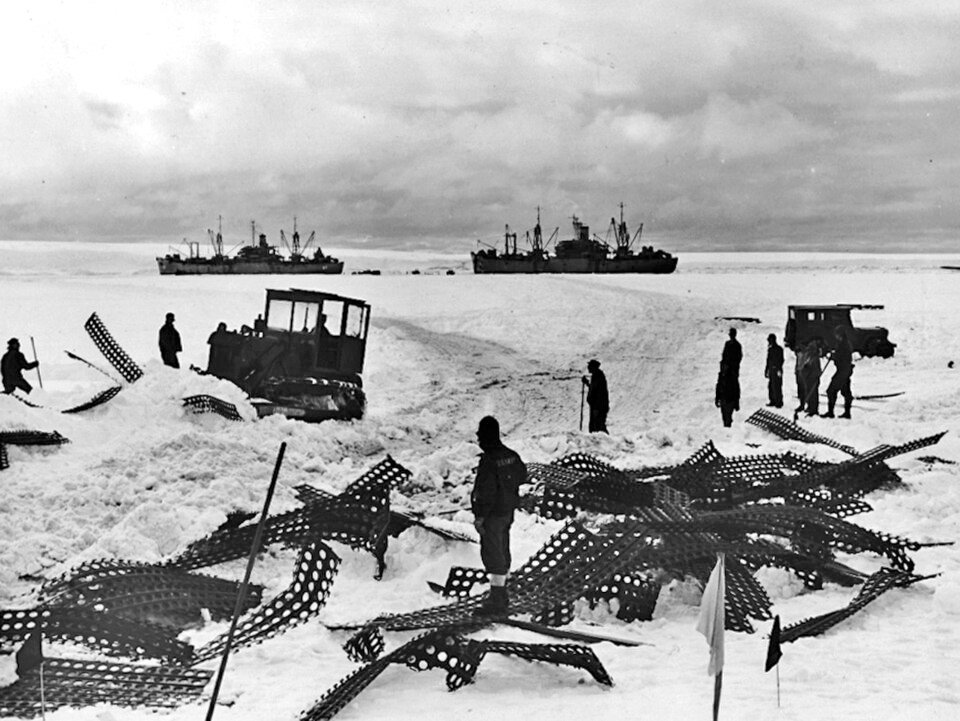
Now the centerpiece. In late 1946 the U.S. Navy mounted Operation Highjump — formally, the Antarctic Developments Program — and its scale still startles: thirteen ships, including the aircraft carrier Philippine Sea, a submarine, destroyers, icebreakers, and tenders; roughly 4,700 men; more than thirty aircraft. Byrd, by then a legend on detached duty, sailed as officer in charge; the task force itself was commanded by Rear Admiral Richard Cruzen. The fleet's stated objectives were published, and the first of them was blunt about geopolitics: "consolidating and extending United States sovereignty over the largest practicable area" of the continent, along with training men and testing machines in extreme cold. The subtext was the new Cold War — if fighting came, it would come across the Arctic, and Antarctica was the available rehearsal space.
The operation's record is thick and public. Three task groups worked the coasts east, west, and center; six R4D transports flew off the carrier's deck to the rebuilt Little America base; Byrd himself overflew the South Pole in mid-February 1947, a bookend to his 1929 flight. The photographic haul ran to some seventy thousand aerial images, the basis of Antarctic mapping for a generation. The costs were real too. On December 30, 1946, the seaplane George 1 flew into a whiteout over the Thurston coast and crashed, killing three of the nine men aboard; the survivors were rescued after thirteen days on the ice. Weeks later a young sailor, Vance Woodall, was killed in a cargo-handling accident on the Ross Ice Shelf.
And yes — the expedition ended early. Planned to run deep into 1947, it wrapped up by late February as the season turned: new ice was closing the leads, and several of the fleet's thin-hulled vessels were poorly suited to being caught in it. The withdrawal was announced, explained, and covered at the time. Reporters, remember, were aboard; newsreel crews shot the whole deployment, and MGM cut their footage into a feature, The Secret Land, which won the Academy Award for best documentary in 1948. It is worth sitting with that fact. The mission conspiracists describe as a suppressed military catastrophe was, within eighteen months, playing in movie theaters — with an Oscar.
What Byrd Actually Said
The myth's favorite exhibit is an interview, and the interview is real. In early March 1947, Lee Van Atta of the International News Service filed a dispatch from aboard the Mount Olympus; it ran in the Santiago daily El Mercurio on March 5. In it, Byrd reflects on what Highjump implied for American security: the poles were no longer remote, aviation had shrunk the world, and in a future war the United States would need defenses against "hostile planes coming from the polar regions," moving at speeds the new age made possible.
Read in 1947, the meaning is unremarkable. Byrd was making the standard great-circle argument of the early Cold War — the shortest route between the Soviet Union and North America runs over the top of the world — and events vindicated him in the form of Arctic radar lines and polar-route bomber patrols. Nothing in the dispatch mentions discs, defeats, lost aircraft, or an enemy in Antarctica; Byrd is talking about the next war's geography, not the last month's casualties. Two further cautions belong on the record. The dispatch survives mainly through a Spanish translation of Van Atta's English copy, so every English version circulating today is a back-translation — a game of telephone across two languages. And the conspiracist rendering quietly performs two edits: the polar warning is moved from the Arctic context to Antarctica, and "planes" become "objects" or "craft." With those two swaps, a sober strategic forecast becomes a survivor's warning about flying saucers at the bottom of the world. The words are Byrd's. The meaning is not.
Two Submarines in Argentina
The German leg of the legend has its own genuine kernel: two U-boats really did appear off Argentina long after the Reich was dead. U-530 surrendered at Mar del Plata on July 10, 1945, more than two months after Germany capitulated; U-977 followed on August 17, having spent sixty-six days submerged on snorkel during its run from Norway — a feat its young captain, Heinz Schäffer, would spend the rest of his life explaining. The Argentine press erupted with speculation that the boats had ferried Hitler, Eva Braun, or Reich treasure to Patagonia, and a Hungarian émigré journalist named Ladislas Szabó bundled the rumors into articles and then a 1947 book, Hitler está vivo — "Hitler Is Alive" — which proposed that the Führer's refuge lay onward, in Antarctica. It is the earliest traceable text placing surviving Nazis on the ice.
The boats themselves told a duller story. Both crews were interrogated at length by Argentine and Allied officers; the vessels were searched; logs, fuel states, and provisioning were checked against the calendar. No passengers, no cargo, no southern detour — later researchers re-ran the fuel-and-time arithmetic and found an Antarctic side trip effectively impossible. Schäffer, exasperated, published his own memoir in 1952 to kill the story, with predictable results. What gave the rumor its long life was the surrounding truth: Nazis really were escaping to Argentina in those years, by ratline rather than U-boat — Eichmann and Mengele most famously, with the Andean resort of Bariloche later yielding the SS captain Erich Priebke. A real migration of war criminals to Patagonia made an imaginary migration to Antarctica feel like one more step down the map. As for the man himself: forensic work on the surviving remains, most recently a 2018 dental analysis by a French medical team, confirms what the 1945 evidence always indicated — Hitler died in Berlin.
Building Base 211
If no expedition built the Antarctic fortress, who did? Writers did, and the construction schedule can be read off the copyright pages. Szabó poured the foundation in 1947. The load-bearing walls went up in 1971, when Wilhelm Landig — a Vienna veteran of the SS — published Götzen gegen Thule, the first of a trilogy he pointedly marketed as "a novel full of realities," in which heroic German remnants operate polar bases and wonder-craft after the war; Landig's circle also incubated the "Black Sun" emblem that now saturates esoteric neo-Nazism. In 1974 the Holocaust denier Ernst Zündel, writing as Christof Friedrich, published UFOs: Nazi Secret Weapons?, complete with saucers from a polar redoubt; in later interviews he cheerfully described the flying-saucer material as a profitable device for drawing curious readers toward his politics. The Chilean diplomat Miguel Serrano supplied the theological wing in the 1980s, recasting Hitler as a hidden avatar awaiting return from the ice. By the 1990s, German-language conspiracy literature had added psychic "Vril maidens" to the drafting room, and in 2005 a magazine serial about a secret postwar British commando war in Neuschwabenland — offered without a single document — completed the modern canon. A Russian television documentary in 2006 contributed "declassified Soviet reports" of Highjump's battle with discs that no archive has ever produced.
Run the searches the believers never run and the pattern is stark. The designation "Base 211" appears in no wartime German document yet located — no order, no manifest, no signal. The two quotations that anchor every version of the story — Grand Admiral Dönitz boasting that his U-boats had built the Führer "an invulnerable fortress" or "a Shangri-La on land" at the ends of the earth — have never been sourced to any speech, record, or transcript; their earliest traceable appearances are in postwar conspiracist literature, quoting one another. The fortress was built the way Agartha was built in Part 2: by books citing books, each generation of authors treating the previous generation's fiction as the historical record. The difference is the workshop. Agartha came out of Parisian occultism. Base 211 came, in large part, out of men with an ideological interest in an undefeated Reich.
The Vril Society and the Bell
Part 2 ended with a promissory note about vril, and here it comes due. The claim: Nazi Germany harbored a "Vril Society" of psychics and engineers who channeled saucer technology from beyond, explaining both the Reich's secret craft and Highjump's defeat. The record: no contemporary document attests any such society. There was a real Thule Society — a Munich völkisch lodge, founded in 1918 around the publicist Rudolf von Sebottendorff, which midwifed the tiny party Hitler later took over and then withered away in the early 1920s; Hitler was never a member and later mocked such circles. The "Vril Society" is a different animal. Its seed is a single aside in a May 1947 Astounding Science Fiction essay by the émigré rocket writer Willy Ley, who recalled a small, eccentric Berlin group that believed in vril — the fictional energy from Bulwer-Lytton's 1871 novel we met last installment. In 1960, the French bestseller The Morning of the Magicians inflated Ley's anecdote into a secret Vril lodge entwined with Thule; decades later, German conspiracy literature added a beautiful psychic medium, Maria Orsic, and her circle of long-haired "Vril maidens," illustrated with photographs no one has ever provenanced. A novel begat an anecdote; the anecdote begat a society; the society begat portraits. That is the entire pedigree.
The Bell hangs on a thread just as thin. Die Glocke — a bell-shaped device of violet glow and lethal fields, allegedly tested in a Silesian mine under SS general Hans Kammler — entered the record in 2000, in a book by the Polish writer Igor Witkowski, who said he had been shown transcripts of a postwar interrogation of an SS officer. The transcripts have never been produced for examination. A British aviation journalist's 2001 bestseller carried the Bell into English, and the concrete ring at Ludwikowice known online as "the Henge" became its launch pad — though industrial historians identify the structure as the frame of an ordinary cooling tower. None of this has kept the Bell out of the myth's engine room: it supplies the "how" for every tale in which Highjump's fleet meets German discs. A weapon known from one unseen document, powering a battle known from zero documents.
The Man Who Moved the Pole
Which leaves the diary — and the diary has a family tree. It begins, innocently, with Byrd's own mouth. Promoting the Navy's return to Antarctica in the mid-1950s, Byrd gave interviews describing the coming expedition's target: the vast unexplored interior on the far side of the South Pole, which he called, in the aviator's plain sense, the land beyond the pole — an area, he told one television interviewer in 1954, as large as the United States and never seen by human eyes. The interview survives on film. When Navy Neptunes made their long trans-Antarctic flights in January 1956, wire copy duly described them penetrating thousands of miles "beyond the pole" — newspaper shorthand for crossing it into the unmapped sector past it. Every word of this concerned territory on the surface of the earth.
Enter F. Amadeo Giannini, a New York mystic with a self-published cosmology, whose 1959 vanity-press book Worlds Beyond the Poles read those phrases with ruthless literalism: if Byrd flew "beyond" the pole and saw land, then land exists beyond the pole — land not on the globe. Giannini also performed the myth's single most consequential act of invention: he asserted that in February 1947 Byrd had made a 1,700-mile flight beyond the North Pole, radioing back descriptions of ice-free lands. No such flight occurred; in February 1947 Byrd was in Antarctica with several thousand witnesses. But the claim found the perfect amplifier — Ray Palmer, the editor who had industrialized the Shaver Mystery in Part 2, and who splashed Giannini's assertions across the December 1959 issue of his magazine Flying Saucers, asking whether Byrd had flown into the hollow earth. When readers pointed out the small matter of which hemisphere Byrd had occupied, Palmer's response was not retraction but escalation: the records, he suggested, had been sealed. Raymond Bernard's 1964 paperback The Hollow Earth — written under a pseudonym by the health-food entrepreneur Walter Siegmeister, who died in South America a year later, reportedly still hunting tunnel entrances — hardened the Giannini-Palmer material into the canon every later author copies.
The "secret diary" itself arrives last, surfacing in the 1970s among American hollow earth enthusiasts — most visibly the International Society for a Complete Earth, a small Missouri outfit whose founder promoted the text and announced plans to reach the polar opening by dirigible. No original document, in Byrd's hand or anyone's, has ever been produced; there is only the typescript, copied and recopied. Its contents are Giannini's flight furnished with 1950s contactee decor: the luminous city, the tall fair hosts the text calls the Arianni, the Master's sorrowful warning about atomic weapons — the standard script of the flying-saucer contact literature that began in 1952, five years after the diary's purported date. The entry recording Byrd's Pentagon silencing is dated, in most circulating copies, March 11, 1947 — which happens, ten years to the day, to be the date of Byrd's actual death in 1957. And the text closes with the line that now decorates a thousand videos:
"That area beyond the Pole... is the center of the Great Unknown." — "The Missing Diary of Admiral Richard E. Byrd," author unknown, first circulated in the 1970s
It is Byrd's authentic 1950s phrase — the unexplored far side of the pole — lifted from its aeronautical meaning and reissued as a deathbed confession. The diary does not merely fail authentication; it helpfully documents its own assembly, quoting the very publicity language whose misreading created it.
Argus, the Treaty, and the Tidy Ending
Every legend wants a third act, and this one has two. The first: that in 1958 the United States finished the job by detonating nuclear weapons over the Nazi base. The reality is Operation Argus — three small warheads lofted by missile hundreds of kilometers above the open South Atlantic in August and September 1958, exoatmospheric physics experiments designed to test whether detonations could pump charged particles into the earth's magnetic field. The shots occurred far from the continent, far above the atmosphere, and were disclosed and reported the following spring. Nothing on the ground, in Antarctica or anywhere else, was targeted.
The second tidy ending is the Antarctic Treaty, signed in Washington on December 1, 1959, and read by believers as the moment the world's powers agreed to seal the continent and its secrets. The text, which is short and public, does nearly the opposite: it demilitarizes Antarctica, dedicates it to open science, freezes territorial claims, and — the clause conspiracy readings must ignore — grants every party the right to inspect every station, installation, and ship on the continent, unannounced. Some thirty nations now operate research programs there, and tens of thousands of tourists visit in a season. A continent under guard would be a poor fit for cruise itineraries. What the treaty actually ended was the sovereignty scramble Highjump had been part of; what it created was the most inspected, least fortified landmass on earth. Here again is the pattern first flagged in Part 1: to the committed, restricted access proves concealment — and so, somehow, does access.
The Continent That Keeps Secrets
None of this means Antarctica lacks mysteries, or that Byrd's story is tidy. The genuine puzzles are simply quieter than the manufactured ones. Whether the Josephine Ford truly rounded the North Pole in 1926 is a live scholarly dispute conducted with real diaries and real erasures. Why a man of Byrd's stature flew a desk so restlessly, wintered alone until it nearly killed him, and filled Alone with sentences about the dark that mythmakers still quarry — that is a question for biographers, and a better one than anything in the typescript diary. The fabricated version pays Byrd the strange insult of replacing an interesting man with a plot device.
As for the assembled legend, its architecture is now visible end to end. Every solid part is real: a German survey ship in 1939, two late U-boats in Argentina, a vast naval operation that left early, a polar warning in a Chilean newspaper, an admiral's poetic phrase about the land beyond the pole. Every joint is fabricated, and every fabrication has a date and a maker: Szabó 1947, Giannini 1959, Palmer 1959, Landig 1971, Zündel 1974, the diary in the 1970s, the Bell in 2000, the maidens in the 1990s, the Soviet "files" in 2006. The lie was never in the parts. The lie is in the joints.
One comparison, and Part 3 can rest. The men who actually died on Operation Highjump have names: Maxwell Lopez, Wendell Hendersin, and Frederick Williams, lost in the George 1 on December 30, 1946, and seaman Vance Woodall, killed on the ice a few weeks later. They have service records, next of kin, and a memorial. The battle of Base 211 — the saucer war that supposedly bloodied a fleet of thousands — has never produced the name of a single casualty, a single hull number, a single page. On one side of the ledger, four men. On the other, none. That is the whole audit.
What remains is the planet itself. Strip away the admirals and the fortresses, and the hollow earth still makes a claim about rock and gravity — a claim that can be tested, and has been, continuously, for two centuries. Part 4 opens the instruments: what Cavendish began, what seismographs and satellites finished, why the shell theorem from Part 1 never moved, and — in fairness — the strongest replies believers offer, examined on their merits. The verdict of the machines is next.
Sources & Further Reading
- Byrd, Richard E. Little America. G. P. Putnam's Sons, 1930; and Alone. G. P. Putnam's Sons, 1938.
- Rawlins, Dennis. "Byrd's Heroic 1926 Flight & Its Faked Last Leg." DIO, Vol. 10 (2000); with the 1926 flight diary held in the Byrd Polar Research Center archives, The Ohio State University.
- U.S. Navy, Task Force 68. Report of Operation Highjump: U.S. Navy Antarctic Developments Program, 1946–47 (1947).
- Van Atta, Lee. International News Service dispatch from aboard USS Mount Olympus, as published in El Mercurio (Santiago), March 5, 1947.
- The Secret Land. MGM documentary feature on Operation Highjump, 1948 (Academy Award, Best Documentary).
- Ritscher, Alfred, ed. Reports of the German Antarctic Expedition 1938/39 (published Leipzig, 1942).
- Summerhayes, Colin, and Beeching, Peter. "Hitler's Antarctic base: the myth and the reality." Polar Record, Vol. 43, No. 1 (2007), pp. 1–21.
- Schäffer, Heinz. U-977. 1952.
- Szabó, Ladislas. Hitler está vivo. Buenos Aires: Editorial Tabano, 1947.
- Ley, Willy. "Pseudoscience in Naziland." Astounding Science Fiction, May 1947.
- Pauwels, Louis, and Bergier, Jacques. Le Matin des magiciens ("The Morning of the Magicians"). Paris: Gallimard, 1960.
- Giannini, F. Amadeo. Worlds Beyond the Poles. Vantage Press, 1959; Palmer, Ray, ed. Flying Saucers, December 1959; Bernard, Raymond. The Hollow Earth. Fieldcrest, 1964.
- "The Missing Diary of Admiral Richard E. Byrd." Anonymous typescript, first circulated in the 1970s.
- Goodrick-Clarke, Nicholas. Black Sun: Aryan Cults, Esoteric Nazism and the Politics of Identity. New York University Press, 2002.
- Witkowski, Igor. Prawda o Wunderwaffe. 2000; Cook, Nick. The Hunt for Zero Point. Century, 2001.
- Charlier, Philippe, et al. "The remains of Adolf Hitler: A biomedical analysis and definitive identification." European Journal of Internal Medicine, Vol. 54 (2018).
- The Antarctic Treaty. Signed Washington, D.C., December 1, 1959.
- Standish, David. Hollow Earth. Da Capo Press, 2006.