The Hollow Earth Files — 5-Part Investigation
In the winter of 1920, a Polish chemist named Ferdinand Ossendowski was running for his life. A veteran of anti-Bolshevik conspiracies in Siberia, he fled south ahead of the Red Army — through the forests of the Yenisei, across the Urianhai wastes, and into Mongolia, traveling by horse and camel among fugitives, bandits, and lamas. Somewhere on that road, by his own account, his Mongol guide abruptly halted the caravan on an empty plain, gestured at the ground beneath them, and explained that they were passing over forbidden territory: the domain of a subterranean kingdom, ancient beyond memory, ruled from below by a being the lamas called the King of the World.
Ossendowski survived, reached the coast, and in 1922 published his escape as Beasts, Men and Gods. The book was an international sensation — a real adventure story, told by a real scientist, that ended with three chapters of the strangest material any bestseller of the decade contained: a detailed account of the underground realm of "Agharti," its millions of inhabitants, its stone libraries, and its hidden sovereign, whose emergence at the end of an age had been prophesied in a Mongolian monastery.
There was one problem, and it took only a few years for Europe's scholars to find it. The underground kingdom Ossendowski described already existed in print — not in any Asian scripture, but in a privately published French book from 1886, written by an occultist who had destroyed almost the entire edition with his own hands.
Part 1 of this series traced the hollow earth as a physical proposition, from Edmond Halley's nested spheres to the Koreshan surveyors on a Florida beach. This installment follows the theory's second life: how the empty interior acquired inhabitants. It is the story of two kingdoms — Shambhala, a genuine and ancient Buddhist tradition, and Agartha, a nineteenth-century French invention — and of how the two were fused, plagiarized, certified, searched for, and spied on until the underground realm became the most durable single element of hollow earth belief. It is also, fair warning, a story in which almost every document turns out to be quoting another document.
The Real Shambhala
Begin with the authentic article, because everything that follows counterfeits it. Shambhala enters the historical record through the Kalachakra — the "Wheel of Time" — a tantric system that appeared in India around the tenth and eleventh centuries and reached Tibet in 1027, a date so foundational that the Tibetan calendar counts from it. In the Kalachakra texts, Shambhala is the kingdom whose ruler received these teachings from the Buddha himself and carried them home. Its geography is precise in the way of sacred geographies: a realm somewhere to the north, ringed by walls of snow mountains, its provinces arranged like the eight petals of a lotus around a luminous capital.
The tradition is also a prophecy. Shambhala's throne passes through a line of kings, and under the last of them, Rudra Chakrin — "the wrathful one with the wheel" — the forces of barbarism will overrun the outer world. In the final battle the king will ride out, the dark age will be broken, and a golden era of the teachings will begin. Traditional calculations place that reckoning in the twenty-fifth century. For nearly a thousand years the prophecy has functioned inside Buddhism much as messianic prophecy functions elsewhere: a horizon of hope, a discipline of preparation, and, occasionally, a political instrument.
Two features of the genuine tradition matter enormously for what came later. First, Shambhala's hiddenness was understood, increasingly, as spiritual rather than cartographic. The tradition even produced its own travel literature — most famously a guidebook to Shambhala composed by the third Panchen Lama in 1775 — but these itineraries blend real Central Asian geography with trials, visions, and purifications, and they read as manuals for transforming the traveler at least as much as directions for moving him; the kingdom, the texts imply, reveals itself to the prepared. The Dalai Lama, who has conferred the Kalachakra initiation dozens of times, has described Shambhala as a pure realm that cannot simply be located on a map. Second — and this cannot be stressed enough — in eight centuries of Kalachakra literature, Shambhala is many things: northern, walled, guarded, veiled, perhaps metaphysical. It is never underground.
Europe brushed against the tradition early. In 1627, two Portuguese Jesuits in Bhutan, Estêvão Cacella and João Cabral, recorded a great northern kingdom their hosts called "Xembala" — Cacella thought it might be Cathay and proposed walking there. Two centuries later the heroic Hungarian philologist Alexander Csoma de Kőrös, compiler of the first Tibetan-English dictionary, published the first scholarly account of the Kalachakra and its "fabulous country in the north," even offering map coordinates — between 45 and 50 degrees north latitude — beyond the Syr Darya. The kingdom now had a Western paper trail. What it did not yet have was a basement.
A Magistrate's City of the Sun
The name that would supply the basement first surfaced not in Lhasa but in the French colonial courts of Bengal. Louis Jacolliot, a magistrate stationed at Chandernagore in the 1860s, returned to France and produced a shelf of books on Indian religion that mixed genuine observation, loose translation, and outright invention in proportions scholars are still untangling. In Le Fils de Dieu — "The Son of God," 1873 — Jacolliot introduced European readers to "Asgartha," a prehistoric City of the Sun, seat of a priest-emperor called the Brahmatma, which he claimed to have reconstructed from ancient manuscripts shown to him by obliging pandits. No one has ever located the manuscripts. Indologists of his own era treated him as unreliable; even Madame Blavatsky, herself no stickler for sourcing, borrowed from Jacolliot with visible caution.
Jacolliot's Asgartha was a lost city of the surface, not a living kingdom below. But the name was now in French print, attached to a hidden priestly capital and a ruler called the Brahmatma — a kit of parts awaiting assembly. The assembler was already taking Sanskrit lessons in Paris.
The Book That Hid Itself
Joseph Alexandre Saint-Yves d'Alveydre was a French occult philosopher with a system to sell. He called it Synarchy — rule by councils of the initiated, the deliberate opposite of anarchy — and he spent the 1880s writing "Mission" books arguing that Europe's salvation lay in adopting it. What Synarchy lacked was a working model. In 1885 Saint-Yves engaged a tutor for Sanskrit lessons, a mysterious figure he called Hardjji Scharipf, and from those lessons — supplemented, Saint-Yves claimed, by direct visits in the astral body — he learned that the model existed, intact, beneath the mountains of Asia.
The result was Mission de l'Inde en Europe, printed in 1886. In its pages, Agarttha — Saint-Yves's spelling — is a vast realm that withdrew underground at the dawn of the present dark age, more than five thousand years ago. Millions live there in synarchic harmony, governed by a Sovereign Pontiff, the Brahmatma, at the head of a sacred hierarchy. Its universities of initiates guard the true archive of human history, engraved in stone, along with sciences the surface world has lost or not yet reached. Periodically its emissaries walk among us, unrecognized, keeping watch. It was, in short, Synarchy with an address — the perfect civilization, conveniently unfalsifiable, one layer down.
Then Saint-Yves did something almost without precedent in the history of crank literature: he suppressed his own revelation. Shortly after printing, he had the edition destroyed — by most accounts a copy or two escaped the pulping, one of them his own. He never gave a clear reason. Ridicule may have frightened him; so, some suggest, did his tutor's displeasure at secrets disclosed. Whatever the motive, the book about a hidden kingdom spent the next quarter century as a hidden book, its contents known only by rumor in Parisian occult circles. When Saint-Yves died in 1909, his admirers — led by the influential occultist Papus — promptly republished it. From 1910 onward, anyone in Europe could read a full technical description of the underground kingdom of Agarttha.
Hold on to that date. Nearly everything the modern internet believes about Agartha — the name, the location, the stone libraries, the world-watching hierarchy, the periodic emergence of its agents — traces to this single, once-destroyed French book. The kingdom did not come out of Asia's scriptures. It came out of a Paris print shop, twice.
One footnote shows how far the ripples ran. Saint-Yves's political doctrine outlived him in the strangest way possible: during the Second World War, occupied France convulsed over rumors of a secret "synarchist" cabal steering the Vichy government from within — a supposed conspiracy investigated by the regime's own police and debated in ministries. Historians who have sifted the files judge the plot itself largely a phantom. But the panic was real, the investigations were real, and the word at the center of it was his. The man who invented an imaginary kingdom to advertise his politics ended up lending his politics to an imaginary conspiracy.
Madame Blavatsky's Hidden Masters
For Saint-Yves's kingdom to conquer the world, the world first had to be prepared to believe that Asia concealed superior beings. That preparation was the work of Helena Petrovna Blavatsky, the Russian émigrée who co-founded the Theosophical Society in New York in 1875 and built it into the most influential esoteric movement of the modern era. Theosophy's central claim was personal: Blavatsky said she was in contact with hidden Masters — adepts of immense age and power, headquartered beyond the Himalayas — who guided humanity's development and communicated, on occasion, by letters that materialized out of the air.
Her second book, The Secret Doctrine of 1888, supplied the deep history: a prehistory of vanished continents — Lemuria, Atlantis — and root races, whose surviving elect withdrew into hidden sanctuaries as their worlds fell. Into this scheme Blavatsky folded Shambhala itself, recast as a refuge of the perfected — an island of adepts in a Gobi sea that had long since turned to desert. Later Theosophists went further and gave the hierarchy a fixed capital: an etheric city called Shamballa, seat of a being they titled the Lord of the World. File that title away; it will reappear shortly, in a Mongolian tent.
Whether any of it was true became a public question almost immediately. In 1884 two disgruntled employees at the society's Indian headquarters produced letters they said showed Blavatsky's miracles were staged; the Society for Psychical Research sent an investigator, Richard Hodgson, whose 1885 report pronounced her an impostor of the first rank. That verdict stood as the official word for a century — until 1986, when the same society's journal published a re-examination arguing that Hodgson's case was biased and methodologically unsound, and the SPR reminded the world it holds no corporate opinions. This series takes no side in that quarrel. What matters here is reach: by 1900, Theosophy had lodges on five continents and had made "hidden Himalayan masters" a household concept from London to Madras. The soil was ready. All Agartha needed was a credible witness.
One more Victorian ingredient went into the mix, and it came from a novelist. Edward Bulwer-Lytton's 1871 bestseller The Coming Race sent its narrator down a mine shaft into the realm of the Vril-ya — serene subterranean superhumans, their women taller and stronger than their men, wielding an all-purpose energy called "vril" — and ended on the quiet threat that they would one day surface and replace us. The book was avowed fiction, but Blavatsky insisted the novelist had described, under an invented name, a force that genuinely existed, and occultists took the hint; the word itself became so current that a beef extract launched at the century's end bottled it into its brand name, Bovril. Keep the word in mind. In Part 3, a phantom "Vril Society" will be retrofitted onto the Third Reich, and a novel's premise will be promoted to a chapter of secret history.
The Fugitive's Tale
Which returns us to Ferdinand Ossendowski, freezing on the Mongolian plateau in 1920. His flight eventually delivered him into the orbit of one of the most frightening men of the century: Baron Roman von Ungern-Sternberg, the "Mad Baron," a renegade White commander who seized the Mongolian capital in 1921 and ruled it briefly in a haze of terror and Buddhist apocalypse — a man who, by multiple accounts, took prophecies of Shambhala's coming war entirely literally, with himself cast in the vanguard. Ossendowski served the Baron's short regime as an advisor, survived it, and got out with his notes.
Beasts, Men and Gods closes with the material the lamas had given him: beneath Asia lies Agharti, a realm of millions reached by tunnels that thread the whole earth, where sciences flourish and the true record of humanity is kept; at its heart rules the King of the World, who sees all surface events and intervenes through emissaries; and in 1890, at the monastery of Narabanchi, the King had appeared and delivered a prophecy of the wars, plagues, and collapses to come — a half century of catastrophe with a precise culmination:
"Then the peoples of Agharti will come up from their subterranean caverns to the surface of the earth." — Prophecy attributed to the King of the World, as recorded in Ferdinand Ossendowski, Beasts, Men and Gods (1922)
The book sold enormously, and the scrutiny arrived on schedule. The great Swedish explorer Sven Hedin — who had actually crossed the regions Ossendowski described — published a book-length attack in 1925, charging that the Agharti chapters were lifted from Saint-Yves d'Alveydre, whose republished Mission de l'Inde had been circulating for a decade, and that the correspondences ran down to the structure of the kingdom and the character of its ruler. Ossendowski swore he had never read Saint-Yves and had reported only what Mongols told him. The dispute might have ended there, as a plagiarism case, had not René Guénon — the French metaphysician and a figure of real intellectual weight — intervened in 1927 with Le Roi du Monde, arguing the reverse: that the very agreement between the two accounts proved both derived from an authentic primordial tradition. The echo, in other words, was the evidence.
Lay the three possibilities on the table, because the whole later history of Agartha rests on which one a reader picks. Either Ossendowski borrowed from a book he denied reading; or Saint-Yves's invention had spent a decade seeping through Russian and Theosophical channels into the very Mongolian circles Ossendowski met, and came back to him wearing lama's robes; or two independent witnesses, forty years apart, described the same real kingdom. Historians of esotericism who have traced the texts overwhelmingly favor some blend of the first two. But note what Guénon's move accomplished for the faithful: a copy was certified as a confirmation. In Part 1 we watched hollow earth literature invent an endorsement from the mathematician Euler. Here the pattern perfects itself — a book echoes a book, a philosopher rules the echo authentic, and from 1927 onward the kingdom below could cite itself as two witnesses.
The Painter, the Secretary, and the Search Parties
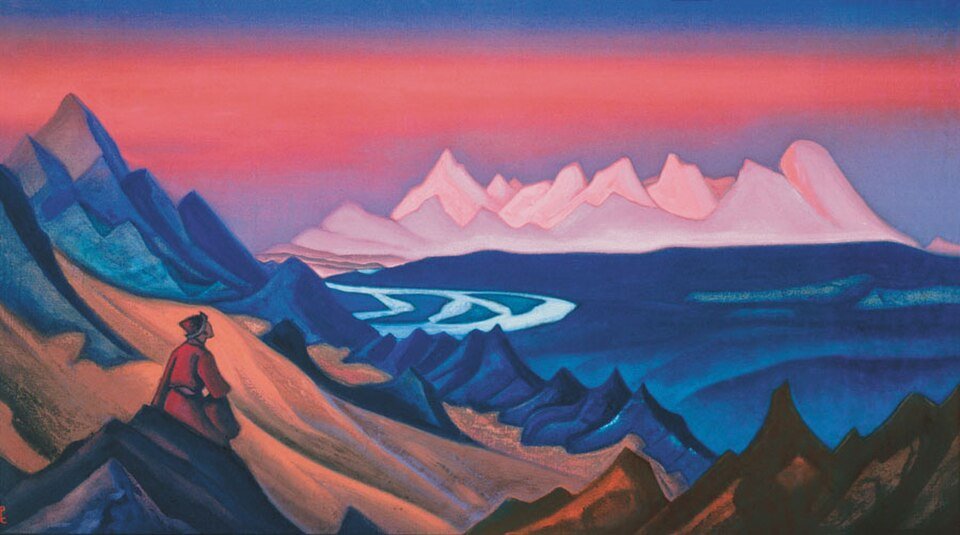
By the 1920s the kingdom had readers in high places, and some of them went looking. Nicholas Roerich — Russian painter of luminous Himalayan canvases, designer of the riot-provoking sets for Stravinsky's Rite of Spring, and, with his wife Helena, founder of a Theosophically flavored teaching of his own — led an expedition through Central Asia from 1925 to 1928 under the American flag, painting, surveying, and listening. Shambhala saturates his account of the journey: rumors of the northern kingdom in every province, signs and prophecies collected like specimens, and the family's own treasured relic — a fragment of a celestial stone, the Chintamani, said to have come from Shambhala itself and to be destined to return. The expedition also detoured to Moscow in 1926, where Roerich delivered a message from the Mahatmas to the Soviet government, and ended in a brutal winter detention on the Tibetan plateau that cost several of his men their lives. None of this made him a marginal figure — within a few years an international treaty on the protection of cultural treasures, the Roerich Pact, would be signed at the White House with President Roosevelt presiding. He never found a gate. In the now-familiar pattern, the failure subtracted nothing from the legend.
Roerich's most consequential admirer was an American cabinet officer. Henry A. Wallace — agricultural scientist, spiritual seeker, Secretary of Agriculture under Franklin Roosevelt, and later vice president of the United States — corresponded with Roerich in letters that opened "Dear Guru." In 1934, at the height of the Dust Bowl, Wallace's department funded a Roerich expedition to Manchuria and Mongolia, officially to collect drought-resistant grasses; the mission's freelance political intrigues embarrassed Washington, and Wallace severed relations the following year. The letters surfaced in the press in 1948, in time to help wreck Wallace's presidential campaign. And one durable myth needs pruning here: Wallace did suggest placing the Great Seal's reverse — the unfinished pyramid and radiant eye — on the dollar bill in the 1930s. But that design was created in 1782 by the seal's official designers. The pyramid was not smuggled onto American money by agents of the underground kingdom; it was dusted off, a century and a half later, by a farm economist who liked its Latin motto.
The Commissar and the Kingdom
The Soviets, meanwhile, opened a file. Declassified materials that surfaced after 1991 — assembled most fully in the historian Andrei Znamenski's Red Shambhala — document a sustained flirtation between the Bolshevik secret police and the hidden kingdom. Its center was Gleb Bokii, the old Bolshevik who ran the OGPU's cipher department, and his collaborator Alexander Barchenko, a writer-researcher convinced that telepathy was real, that a prehistoric science survived in inner Asia, and that Shambhala was its vault. Barchenko had first won official patronage in the early 1920s with an expedition to the Kola Peninsula, above the Arctic Circle, to study a mysterious trance-sickness among the indigenous Sami — fieldwork strange enough to impress the right commissars. Through the mid-1920s he and Bokii studied psychic phenomena in a laboratory setting and planned a covert expedition toward Tibet to make contact — a scheme ultimately strangled by rivals in the foreign affairs commissariat. Both men were shot in the purges, Bokii in 1937 and Barchenko in 1938, their Shambhala files sealed for half a century.
The interest was not merely mystical. In Mongolia's revolutionary wars, partisan songs promised fighters rebirth in the army of Shambhala; the Panchen Lama's flight from Tibet in 1923 sent prophetic expectation rolling across the steppe; and in the decades that followed, Japanese agents working Inner Asia would try the same hymnbook, casting their empire in messianic Buddhist terms. By the 1930s, the hidden kingdom had achieved something no other hollow earth idea ever managed: it was an object of active interest to the intelligence services of multiple great powers — not because commissars believed in tunnels, but because millions of believers were a force worth steering.
America Digs Its Own
The United States, characteristically, did not import the kingdom so much as franchise it. The American branch grew around a volcano: Mount Shasta in northern California, whose career as an occult address began with A Dweller on Two Planets, a novel channeled — so he said — by a Yreka teenager named Frederick Spencer Oliver in the 1880s and published by his mother in 1905. Oliver's book placed a secret sanctuary of Atlantean adepts inside the mountain. In 1931 the legend received two boosts in a single year: a credulous Los Angeles Times magazine feature reported a mystic village of "Lemurians" on Shasta's slopes, and a Rosicrucian-published book, Lemuria: The Lost Continent of the Pacific, gave the survivors a pedigree. Three years later Guy Ballard, a mining engineer who said he had met the Ascended Master Saint Germain while hiking the mountain in 1930, published Unveiled Mysteries and launched the "I AM" movement — complete with a geography of hollowed-out sacred retreats inside the mountains of the American West. Shasta's underground city acquired a name, Telos, and a thriving modern mythology whose current residents will appear in Part 5.
The Kingdom Goes to Press
Step back to the eve of the Second World War and take inventory. The underground kingdom now existed simultaneously in three registers: as scripture, in the living Kalachakra tradition, which had never put it underground at all; as occult geography, in the Saint-Yves–Ossendowski–Guénon chain, where texts certified texts; and as a state file, in USDA expedition budgets and OGPU expedition plans. It remained only for the kingdom to be democratized, and American newsstands obliged.
In March 1945, Amazing Stories ran "I Remember Lemuria!" — the purported racial memories of a Pennsylvania welder named Richard Shaver, aggressively rewritten by the magazine's editor, Ray Palmer, describing malevolent degenerate beings, the "dero," tormenting humanity from ancient caverns beneath our feet. Palmer presented it not as fiction but as suppressed truth, and the readership responded with tens of thousands of letters and a surge in circulation that kept the "Shaver Mystery" running for years. The maneuver had a pedigree — as far back as 1908, a novel called The Smoky God had framed a voyage through the polar opening as a dying sailor's true confession — but Shaver and Palmer industrialized it. The kingdom below now belonged to anyone with a quarter for a pulp, and it had turned hostile.
And while the pulps hummed, the United States Navy was assembling the largest expedition ever sent to Antarctica, under the command of the most famous polar explorer alive. What Admiral Richard E. Byrd actually did on Operation Highjump, what he actually said about it, how a German U-boat surrender in Argentina fed a myth of surviving Nazis at the pole, and how a "secret diary" Byrd never wrote became the hollow earth's most quoted document — that is Part 3.
As for the kingdom's founder: Saint-Yves d'Alveydre had fed his own revelation to the pulper in 1886, and it had not mattered. He could destroy an edition. The address had already escaped.
Sources & Further Reading
- The Kālacakra Tantra and commentarial literature (11th century). For an accessible scholarly study: Bernbaum, Edwin. The Way to Shambhala: A Search for the Mythical Kingdom Beyond the Himalayas. Anchor Press, 1980.
- Cacella, Estêvão. Letter from Bhutan describing the kingdom of "Xembala" (1627), in Wessels, C. Early Jesuit Travellers in Central Asia, 1603–1721. The Hague: Martinus Nijhoff, 1924.
- Csoma de Kőrös, Alexander. "Note on the Origin of the Kála-Chakra and Adi-Buddha Systems." Journal of the Asiatic Society of Bengal, Vol. 2 (1833).
- Jacolliot, Louis. Le Fils de Dieu. Paris: Albert Lacroix et Cie, 1873.
- Saint-Yves d'Alveydre, Alexandre. Mission de l'Inde en Europe. Privately printed, 1886; republished Paris: Dorbon-Aîné, 1910.
- Bulwer-Lytton, Edward. The Coming Race. Edinburgh: William Blackwood and Sons, 1871.
- Blavatsky, H. P. The Secret Doctrine. London: Theosophical Publishing Company, 1888.
- Hodgson, Richard, et al. "Report of the Committee Appointed to Investigate Phenomena Connected with the Theosophical Society." Proceedings of the Society for Psychical Research, Vol. 3 (1885); and Harrison, Vernon. "J'Accuse: An Examination of the Hodgson Report of 1885." Journal of the Society for Psychical Research, Vol. 53 (1986).
- Ossendowski, Ferdinand. Beasts, Men and Gods. New York: E. P. Dutton, 1922.
- Hedin, Sven. Ossendowski und die Wahrheit. Leipzig: F. A. Brockhaus, 1925.
- Guénon, René. Le Roi du Monde ("The King of the World"). Paris, 1927.
- Roerich, Nicholas. Altai-Himalaya: A Travel Diary. Frederick A. Stokes, 1929; and Shambhala. Frederick A. Stokes, 1930.
- Culver, John C., and Hyde, John. American Dreamer: The Life and Times of Henry A. Wallace. W. W. Norton, 2000 — on the Roerich expedition and the "Dear Guru" letters.
- U.S. Department of State. The Great Seal of the United States — on the 1782 design of the seal's reverse and its 1935 placement on the one-dollar bill.
- Znamenski, Andrei. Red Shambhala: Magic, Prophecy, and Geopolitics in the Heart of Asia. Quest Books, 2011.
- Godwin, Joscelyn. Arktos: The Polar Myth in Science, Symbolism, and Nazi Survival. Thames & Hudson, 1993.
- Oliver, Frederick Spencer. A Dweller on Two Planets. Baumgardt Publishing, 1905; Cervé, Wishar S. Lemuria: The Lost Continent of the Pacific. AMORC, 1931; King, Godfré Ray. Unveiled Mysteries. Saint Germain Press, 1934.
- Shaver, Richard S. (with Ray Palmer). "I Remember Lemuria!" Amazing Stories, March 1945.