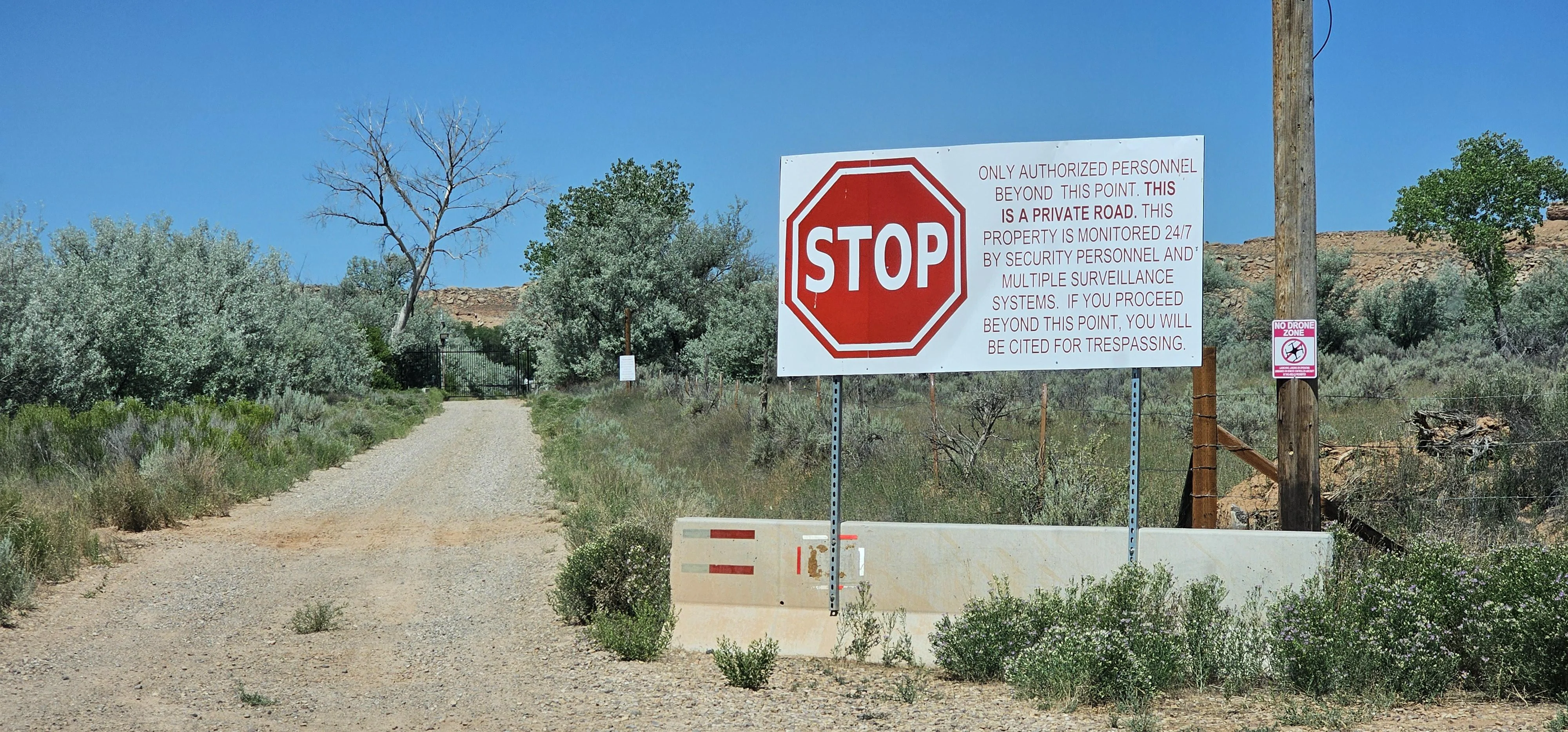
The Skinwalker Ranch Files — 6-Part Investigation
In the high desert of northeastern Utah, in a remote basin locals have described as wrong for as long as anyone can remember, sits 512 acres of ranchland that has produced more documented anomalies — and more serious scientific and government attention — than almost any other location associated with the paranormal in American history.
It has been surveilled by a privately funded scientific team for nearly a decade. It triggered a classified Pentagon program that spent $22 million in taxpayer money. It has generated eyewitness accounts from ranchers, biochemists, aerospace engineers, and active-duty military personnel. It has been the subject of two books written by program insiders, a running History Channel series, and thousands of pages of investigation reports.
And despite all of that, it has produced no definitive proof of anything.
That contradiction — the sheer volume of serious attention versus the total absence of conclusive evidence — is precisely what makes Skinwalker Ranch worth examining carefully. This is a six-part investigation. We will work through the history chronologically, examine the evidence as it was documented at the time, present the competing explanations, and let you draw your own conclusions.
We start at the beginning.
The Land Before Sherman
Skinwalker Ranch sits in the Uintah Basin of northeastern Utah, a high-altitude semi-desert of roughly 4,500 square miles bounded by the Uinta Mountains to the north and the Book Cliffs to the south. The basin is geologically unusual — it sits atop one of the largest deposits of oil shale in the world, its subsurface riddled with natural gas pockets and mineral formations that produce measurable electromagnetic anomalies.
For centuries before any European explorer set foot in the basin, it was Ute territory. The Ute people, whose oral traditions regarding this specific stretch of land are among the oldest documented accounts associated with the ranch, speak of the area around what is now called Skinwalker Ranch as a place to be avoided. According to multiple ethnographic records compiled by researchers in the 20th century, the Ute referred to the path through the basin as belonging to the skinwalker — a concept they attributed not to their own tradition but to the Navajo.
The historical context here matters. The relationship between the Ute and the Navajo was marked by prolonged territorial conflict. According to historian Sondra Jones, author of Being and Becoming Ute, the Navajo were historically more aggressive in the region and had at various points taken Ute slaves. Local oral tradition holds that a territorial dispute led the Navajo to curse the land with skinwalkers — malevolent shapeshifting witches from Navajo cosmology who had committed heinous acts to gain supernatural power.
Whether or not one accepts the metaphysical claim, the documented fact is this: the Ute largely refused to enter this specific area and described it, consistently across generations, as cursed or otherwise dangerous. This is not campfire legend. It is a documented pattern of avoidance that predates the Sherman family's arrival by centuries.
UFO Alley: The 1970s Reports
Before the Sherman family ever purchased the ranch in 1994, the Uintah Basin had already developed a significant documented history of aerial phenomena. In the 1970s, UFO sightings in the basin became so frequent that the Utah Highway Patrol reportedly stopped filing individual incident reports — there were simply too many. Investigative journalist Joseph Junior Hicks, a junior high school teacher from Roosevelt, Utah, spent decades cataloguing reported sightings in the basin and eventually compiled a database of more than 400 cases from the region, with over 200 occurring within a concentrated corridor that would later be called UFO Alley — a stretch of highway running directly past what would become Skinwalker Ranch.
These were not isolated incidents from fringe figures. They included sightings by law enforcement officers, multiple-witness events, and cases that generated physical evidence including ground impressions and burned vegetation. The documented history of aerial anomalies in the Uintah Basin, beginning years before the Sherman family's tenancy, is one of the most significant and overlooked aspects of the Skinwalker Ranch case. Whatever was happening on that 512-acre property did not begin in 1994.
What the Name Actually Means
The term "skinwalker" (yee naaldlooshii in Navajo, meaning "with it, he goes on all fours") refers to a specific figure in Navajo tradition: a witch who has achieved the ability to transform into an animal by wearing its skin. According to Navajo belief, becoming a skinwalker requires committing a terrible act — typically the murder of a close family member — as the price of supernatural power. Skinwalkers are described in Navajo oral tradition as capable of moving at extraordinary speed, mimicking human voices, and causing illness in those they target. They are among the most feared entities in Navajo cosmology.
The ranch sits on the border of the Uintah and Ouray Indian Reservation, and the Ute association of the land with Navajo skinwalkers reflects a specific historical narrative about who was responsible for whatever malevolence was perceived in the area. Some Navajo scholars and cultural authorities object to public discussion of skinwalkers, arguing that speaking of them draws their attention — which is why documentation of the traditional accounts is limited.
The Previous Owners
One of the most frequently cited skeptical arguments about Skinwalker Ranch focuses on the family who owned it for approximately 60 years before the Shermans. By their own account, they experienced nothing unusual during that entire tenancy. When pressed by researchers, former members of the family stated categorically that no paranormal events of any kind had occurred on the property.
Skeptic Robert Sheaffer has pointed to this as the strongest evidence against the ranch's reputation: if the phenomena were intrinsic to the land, why did they not manifest for 60 years? This is a legitimate challenge without a clean answer. What is documented is that the transition from one family to another coincided precisely with the beginning of an intense and sustained period of reported anomalous activity.
The Basin Context
The Uintah Basin's geological profile is unusual in ways that may be relevant. The basin sits atop significant natural gas deposits, and methane seeping through fissures can produce atmospheric phenomena under certain conditions — luminous effects, disorientation in animals, and in rare cases physiological effects in humans. The basin also lies within an area of elevated geomagnetic variability that has been noted by researchers studying the relationship between geological features and anomalous reports.
None of this explains the full range of what has been reported at Skinwalker Ranch. But it establishes that the basin is not geologically ordinary, and that natural explanations for at least some of the reported phenomena cannot be dismissed without thorough investigation.
Setting the Stage
By the time Terry and Gwen Sherman purchased the ranch in 1994, they were acquiring a property that sat within a documented multi-decade UFO sighting corridor, a region with centuries of indigenous avoidance traditions, a geologically anomalous basin with measurable electromagnetic irregularities, and a location that had generated no known anomalous reports under a 60-year prior tenancy.
The Sherman family knew none of this when they signed the papers. They were ranchers looking for a place to raise cattle. What happened next — beginning within days of their arrival — transformed a quiet piece of Utah ranchland into the most intensively studied paranormal location in American history.
Sources & Further Reading
- Jones, Sondra. Being and Becoming Ute. Utah State University Press, 2000.
- Kelleher, Colm A. and Knapp, George. Hunt for the Skinwalker. Paraview Pocket Books, 2005.
- Hicks, Joseph Junior. Documented UFO sighting database, Uintah Basin (1950s–2000s).
- Van Eyck, Zack. "Frequent Flyers?" Deseret News, June 30, 1996.
- Sheaffer, Robert. Skeptical analysis of Skinwalker Ranch claims. BadUFOs.com.
- Devereux, Paul. Earth Lights Revelation. Blandford Press, 1989.