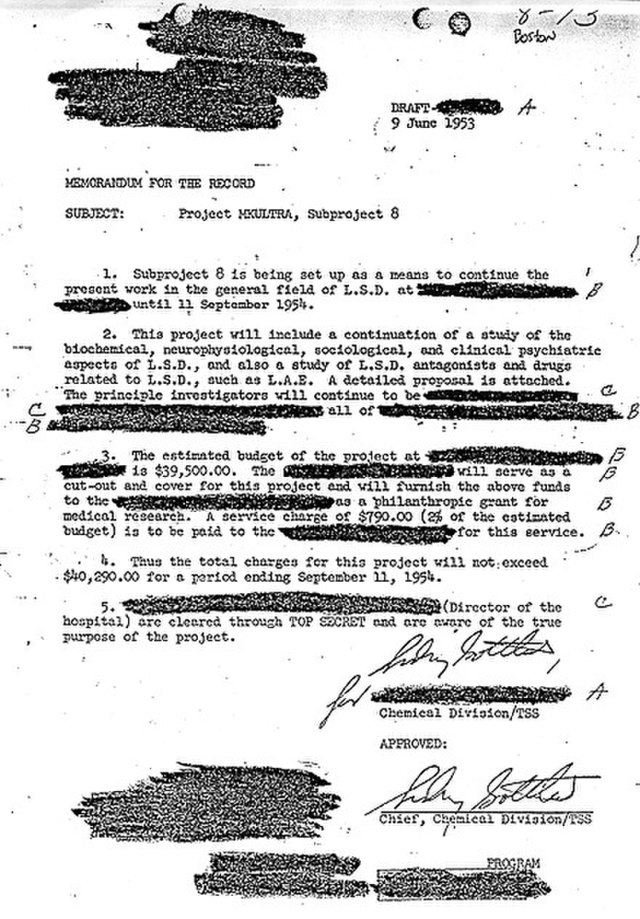
When the United States Senate convened hearings in August 1977 to investigate the Central Intelligence Agency's covert research into human behavior modification, the testimony that emerged was not the stuff of conspiracy theory. It was the documented, government-acknowledged reality of a program that had operated for two decades in near-total secrecy — a program that tested LSD on unwitting subjects, experimented with hypnosis and sensory deprivation, funded torture research disguised as psychiatry, and destroyed the majority of its own records before anyone could review them.
The program was called MKUltra. It was real. It existed. And what we know about it may represent only a fraction of what actually occurred.
Origins: The Cold War Context
To understand MKUltra, you have to understand the paranoia that produced it. In the early 1950s, American intelligence officials became convinced that the Soviet Union, China, and North Korea had developed techniques for controlling the human mind. American prisoners of war returning from Korea appeared to have been subjected to intense psychological manipulation — some had made public statements denouncing the United States.
The CIA's response was to launch its own program. What began as defensive research — understanding what the enemy might be capable of — quickly evolved into something far more aggressive.
MKUltra was formally authorized on April 13, 1953, by CIA Director Allen Dulles. It was placed under the control of Sidney Gottlieb, a chemist who would become one of the most consequential — and most disturbing — figures in the history of American intelligence. Gottlieb reported directly to the Deputy Director of Plans, bypassing normal oversight channels entirely.
What MKUltra Actually Did
At its peak, MKUltra comprised 150 separate research projects contracted to 80 institutions — universities, hospitals, prisons, and pharmaceutical companies. The subjects ranged from volunteer prisoners who were paid to participate to hospital patients, mental health facility residents, and ordinary citizens who were given drugs and subjected to procedures without their knowledge or consent.
LSD Experiments
Lysergic acid diethylamide (LSD) was central to MKUltra's research from the beginning. Gottlieb believed LSD might serve as a truth serum, a method of disorientation, or a tool for creating psychological instability in enemy agents. What the program actually discovered was that LSD's effects were wildly unpredictable — which didn't stop the experiments from continuing for years.
The most notorious LSD operation was Operation Midnight Climax, run by CIA officer George White. Safe houses were established in San Francisco and New York where prostitutes hired by the CIA would bring in unwitting clients. The men would be dosed with LSD without their knowledge while White observed from behind a two-way mirror. These operations ran from the mid-1950s into the 1960s.
The Frank Olson Case
On November 19, 1953, Frank Olson — a U.S. Army biological weapons researcher working with the CIA — was dosed with LSD without his knowledge during a retreat at Deep Creek Lake, Maryland. He began exhibiting severe psychological distress. Nine days later, he fell from the window of a New York hotel room on the 10th floor and died.
His death was ruled a suicide. His family was told he had jumped during a mental breakdown. They were not told he had been given LSD without his consent.
In 1975, the Rockefeller Commission revealed that a U.S. government employee had died in connection with drug experimentation. The Olson family recognized Frank. President Ford apologized. The CIA settled with the family.
But in 1994, Frank Olson's body was exhumed. A forensic examination by Dr. James Starrs of George Washington University found evidence of a blow to the head that had occurred before the fall — evidence, Starrs concluded, consistent with homicide rather than suicide. The case has never been officially reopened.
The Cameron Experiments
Among the most disturbing subprojects was Subproject 68, run by Dr. Ewen Cameron, then-president of the American Psychiatric Association, at McGill University's Allan Memorial Institute in Montreal. Cameron received CIA funding for experiments he called "psychic driving" — a process designed to erase existing mental patterns and implant new ones.
His methods included:
- Drug-induced sleep lasting weeks or months at a time
- Electroconvulsive therapy administered at 30 to 40 times the normal intensity
- Sensory deprivation in specially constructed isolation chambers
- Repetitive audio messages played for hours or days continuously
The patients subjected to these procedures — many of whom had been admitted for relatively minor conditions like anxiety and depression — suffered devastating, permanent psychological damage. Many lost years of memories. Some forgot how to speak. In 1988, the Canadian government settled with Cameron's survivors for $100,000 each. The CIA has never formally acknowledged the full scope of its role in Cameron's work.
The 1973 Document Destruction
In January 1973, as Watergate began unraveling the Nixon administration and congressional scrutiny of intelligence agencies intensified, CIA Director Richard Helms ordered the destruction of all MKUltra files. Sidney Gottlieb personally oversaw the shredding of seven boxes of documents at CIA headquarters.
What survived did so by accident. A separate cache of approximately 20,000 documents had been misfiled in a financial records building rather than the main CIA archive. These records were discovered during a Freedom of Information Act search in 1977 — and they became the foundation for everything the public knows about MKUltra today.
The implications are significant: what we know represents the documents that survived by bureaucratic error. The deliberately preserved record was destroyed.
The 1977 Senate Hearings
The Senate Select Committee on Intelligence, chaired by Senator Daniel Inouye, convened hearings in August 1977. Sidney Gottlieb testified under oath. Admiral Stansfield Turner, then CIA Director, provided a formal briefing.
What was confirmed in testimony:
- MKUltra had operated 150 subprojects across 80 institutions
- Drug experiments had been conducted on unwitting subjects
- The program had operated outside normal oversight channels
- The majority of records had been deliberately destroyed
What Gottlieb claimed under oath: that MKUltra had ultimately been "not a high pay-off program" and had not produced the breakthroughs its architects had hoped for. Critics noted that Gottlieb had destroyed the records that could have verified or contradicted this claim.
The Theories: What We Don't Know
Theory 1: The Official Narrative
The CIA's position, largely accepted in mainstream historical accounts, is that MKUltra was an aberrant program born of Cold War paranoia, operated by rogue elements who exceeded their authority, and ultimately failed to achieve its objectives. It was shut down, disclosed to Congress, and represents a closed chapter.
The evidence for this: MKUltra was formally terminated. No current program has been publicly identified as a successor. The Senate hearings produced substantial disclosure.
The evidence against: the primary records were destroyed before anyone could examine them. Gottlieb's testimony about the program's failure cannot be independently verified. The oversight failures that allowed MKUltra to operate were never fully remediated.
Theory 2: MKUltra Never Truly Ended
A significant body of researchers and former intelligence officials have argued that the behavioral modification research conducted under MKUltra continued under different program names after the official termination. Programs including MKSEARCH, which ran until at least 1972, and various classified Defense Department research initiatives have been cited as potential continuations.
The evidence: declassified documents show that MKSEARCH explicitly continued several MKUltra subprojects after the main program's official end date. The methodological similarities between MKUltra-era research and interrogation techniques documented at Abu Ghraib and Guantanamo Bay — including sleep deprivation, sensory disorientation, and stress positions — have been noted by multiple historians and human rights researchers.
Theory 3: MKUltra Was the Tip of the Iceberg
Given that the surviving documents represent records that survived by accident, some researchers argue that MKUltra as publicly understood represents only the visible portion of a far larger program. The predecessor programs — Project Bluebird (1950) and Project Artichoke (1951) — had their own separate documentation, much of which remains classified or was similarly destroyed.
Project Artichoke, in particular, explored interrogation techniques that went significantly beyond what has been disclosed about MKUltra, including research into inducing amnesia, creating "disposable" agents who could be programmed and then have their programming erased, and the use of hypnosis combined with chemical agents.
What We Know for Certain vs. What Remains Unknown
Confirmed facts:
- MKUltra operated from 1953 to at least 1973 under CIA authority
- It conducted experiments on unwitting subjects including civilians
- At least one person — Frank Olson — died in connection with the program
- The majority of records were deliberately destroyed on CIA Director Helms' orders
- Subproject 68 under Ewen Cameron caused severe, documented harm to psychiatric patients
- The program operated outside normal Congressional oversight for its entire existence
What remains unknown:
- The full scope of experiments conducted — the destroyed records contained this information
- The total number of unwitting subjects — there is no way to determine this from surviving records
- Whether Frank Olson was murdered — the forensic evidence remains disputed and the case has never been officially reopened
- Whether successor programs continued MKUltra's research under different names
- Whether the techniques developed under MKUltra directly informed post-9/11 enhanced interrogation programs
What is not in dispute is this: a program of this scope, operating with this level of secrecy, causing this level of harm, for this length of time — was real. It happened. The government acknowledged it. And the records that would tell us the full truth were fed into a shredder by the man who ran it.
Sources & Further Reading
- U.S. Senate Select Committee on Intelligence. Project MKUltra, the CIA's Program of Research in Behavioral Modification. Joint Hearing, August 3, 1977.
- CIA Inspector General Report on MKULTRA (1963), declassified 1977
- Marks, John. The Search for the Manchurian Candidate. Times Books, 1979.
- Ross, Colin A. The CIA Doctors: Human Rights Violations by American Psychiatrists. Manitou Communications, 2006.
- Kinzer, Stephen. Poisoner in Chief: Sidney Gottlieb and the CIA Search for Mind Control. Henry Holt, 2019.
- Rockefeller Commission Report (1975), Chapter 15: "Experimentation with Drugs and Other Agents"
- Starrs, James E. Forensic report on exhumation of Frank Olson (1994), George Washington University
- Freedom of Information Act releases, CIA CREST database