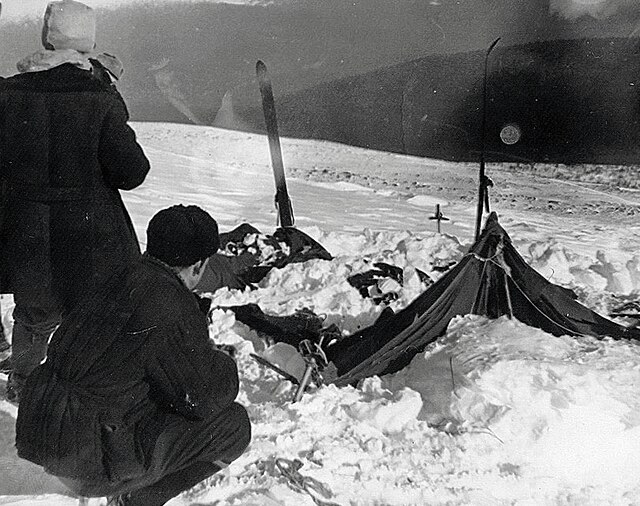
On the night of February 1, 1959, nine experienced hikers slashed their way out of their own tent in the Ural Mountains, fled into temperatures that had plunged below negative 30 degrees Celsius, and never came back alive. Some were found barefoot. Some were found in their underwear. One was missing her tongue. The Soviet government concluded they had been killed by "a compelling natural force" — and promptly sealed the case files.
More than six decades later, the Dyatlov Pass incident remains one of the most debated unsolved mysteries in modern history. What follows is everything we know — the facts, the evidence, the theories — and the uncomfortable truth that none of the explanations fully add up.
The Group: Who Were They?
The expedition was organized by 23-year-old Igor Alekseyevich Dyatlov, a radio engineering student at the Ural Polytechnical Institute (now Ural Federal University) in Sverdlovsk, Soviet Union. Dyatlov was known as a meticulous planner who had already led several difficult treks. This expedition was intended to earn the group their Grade III hiking certification — the highest difficulty classification available in the Soviet Union at the time.
The nine hikers who would ultimately perish were:
- Igor Dyatlov, 23 — Expedition leader, radio engineering student
- Zinaida Kolmogorova, 22 — Radio engineering student
- Lyudmila Dubinina, 20 — Economics student, known for her strong will and athleticism
- Alexander Kolevatov, 24 — Nuclear physics student
- Yuri Doroshenko, 21 — Radio engineering student
- Yuri Krivonischenko, 23 — Engineering graduate who had worked at the Mayak nuclear facility
- Rustem Slobodin, 23 — Engineering graduate
- Nikolai Thibeaux-Brignolle, 23 — Civil engineering student of French heritage
- Semyon Zolotaryov, 37 — A World War II veteran and sports instructor who joined the group as a last-minute addition
A tenth member, Yuri Yudin, turned back on January 28 due to knee and joint pain. He was the only member of the original group who survived. Yudin would spend the rest of his life haunted by the fate of his friends, passing away in 2013.
The Journey: January 23 – February 1, 1959
On January 23, 1959, the group received their official route book. Their goal was to reach Mount Otorten, located in the northern Ural Mountains — a 14-day expedition covering roughly 300 kilometers through some of the most remote terrain in the Soviet Union.
January 28 — Yuri Yudin turned back due to illness. He said goodbye to his friends, not knowing it would be the last time he would see any of them alive.
February 1 — The hikers began their ascent through the mountain pass toward Kholat Syakhl (which translates, ominously, to "Dead Mountain" in the Mansi language). A snowstorm moved in, reducing visibility. Rather than descend into the forest to make camp, Dyatlov decided to push on and set up camp partway up the slope — a decision that would prove fatal.
That is the last confirmed moment any of the nine were alive.
The Discovery
When the group failed to send their scheduled telegram on February 12, no immediate alarm was raised — delays were not unusual on expeditions of this kind. It was only on February 20 that a search party was dispatched.
What they found was deeply disturbing. The tent had been slashed open from the inside. Nine sets of tracks led away from it in an orderly pattern — then disappeared under snow. The hikers had clearly left in an extreme hurry and without adequate clothing or equipment.
The first five bodies were found in the days that followed. Three were discovered on the slope between the tent and the tree line, apparently trying to return to camp. Two were found near the remains of a fire at the edge of the forest, stripped of clothing that appeared to have been cut from their bodies.
The final four bodies were recovered in May, beneath several meters of snow in a ravine 75 meters from the tree line. These four had the most disturbing injuries.
The Injuries: What the Autopsies Found
Six of the nine died from hypothermia. The other three — Nikolai Thibeaux-Brignolle, Lyudmila Dubinina, and Semyon Zolotaryov — died from catastrophic internal trauma.
- Thibeaux-Brignolle had massive skull fractures with no external wounds
- Dubinina and Zolotaryov had broken ribs so severe the forensic examiner compared the force required to that of a car crash
- Dubinina was missing her tongue, eyes, and lips — soft tissue that disappeared after death, though whether by decomposition, scavengers, or other means was disputed
- Several clothing items showed elevated levels of radioactive contamination
The lead forensic investigator, Boris Vozrozhdenniy, concluded that the internal trauma was caused by an "unknown compelling force" and specifically noted it could not have been caused by another human being — the force involved was simply too great and left no external bruising consistent with a beating.
The Theories
Theory 1: Slab Avalanche
The most scientifically supported explanation holds that a delayed slab avalanche — triggered by the hikers cutting into the snowpack to pitch their tent — released while they slept, causing them to cut their way out in panic and flee into the dark.
The most significant scientific contribution came in January 2021, when researchers Johan Gaume and Alexander Puzrin published peer-reviewed research in Communications Earth & Environment. Using analytical models for snow slab mechanics and numerical body models originally developed for car crash testing, they demonstrated that even a relatively small slab could produce the specific injury patterns documented in the autopsies.
However, even the researchers acknowledged it was not definitive proof. The slope angle at the campsite — around 23 degrees — is below the typical threshold for avalanche release. No other search party members reported seeing avalanche debris. And the orderly footprint pattern leading away from the tent is inconsistent with a group in full avalanche panic.
Theory 2: Military or Government Testing
Several anomalies have led researchers to suspect covert military activity. The radioactive contamination found on clothing items was never fully explained. Orange spheres were reported in the sky above the Ural Mountains in the weeks surrounding the deaths by multiple independent witnesses. Krivonischenko had previously worked at the Mayak nuclear facility — site of a major 1957 nuclear accident that was covered up by the Soviet government for decades.
Proponents of this theory argue the Soviet investigation was deliberately superficial, the case files were sealed for decades, and several investigators were reportedly ordered to reach a specific non-conclusion. Against this: no physical evidence of weapons testing has been confirmed, and the radioactive contamination levels, while elevated, were within ranges that could have benign explanations.
Theory 3: Infrasound
A theory proposed by Russian researcher Donnie Eichar suggests that the unique topography of Kholat Syakhl could have generated infrasound — low-frequency sound waves below human hearing — powerful enough to cause panic, disorientation, and intense physiological distress. Infrasound at certain frequencies is known to cause anxiety, feelings of dread, and in some documented cases, visual disturbances.
The weakness: there is no direct physical evidence that infrasound was present that night, and the theory cannot explain the catastrophic physical injuries suffered by the ravine victims.
Theory 4: Mansi Attack
Early investigators considered the possibility that the indigenous Mansi people, who considered Kholat Syakhl sacred ground, may have attacked the hikers for trespassing. This theory was definitively ruled out by investigators. No evidence of any other people at the scene was found. The Mansi who were interviewed cooperated fully with the investigation. And the injuries, again, were inconsistent with a human attack.
What We Know for Certain
- Nine experienced hikers died on the night of February 1-2, 1959
- They cut their way out of their tent from the inside
- They fled into extreme cold without adequate clothing
- Six died of hypothermia; three died of severe physical trauma
- No evidence of any other people was found at the scene
- Radioactive contamination was detected on some clothing
- The Soviet investigation was closed after three months with an ambiguous conclusion
Final Thoughts
The Dyatlov Pass incident endures because it sits at the intersection of verified tragedy and genuine mystery. These were not anonymous figures — they were young people with diaries full of inside jokes, cameras full of candid photographs, and lives full of ambition. The recovered film shows them laughing, building snow shelters, mugging for the camera. The normalcy of those images makes the horror of what followed all the more disturbing.
The slab avalanche theory may be the most scientifically supported explanation. But even its proponents acknowledge it doesn't perfectly account for every anomaly. And that gap — between what we can explain and what we can't — is why, more than 65 years later, people are still searching for answers on a frozen Russian mountainside.
Whatever killed them, the mountain remembers.
Sources & Further Reading
- Gaume, J. & Puzrin, A. "Mechanisms of slab avalanche release and impact in the Dyatlov Pass incident in 1959." Communications Earth & Environment 2, Article 1 (2021).
- Soviet Investigation Case File No. 01/2934 (1959), declassified post-1991
- Dyatlov Memorial Foundation Archives — dyatlovpass.com
- Eichar, Donnie. Dead Mountain: The Untold True Story of the Dyatlov Pass Incident. Chronicle Books, 2013.
- McCloskey, Keith. Mountain of the Dead: The Dyatlov Pass Incident. The History Press, 2013.
- Autopsy reports by forensic pathologist B.A. Vozrozhdenniy (March–May 1959)
- Associated Press coverage of the 2019 Russian government reopening of the case